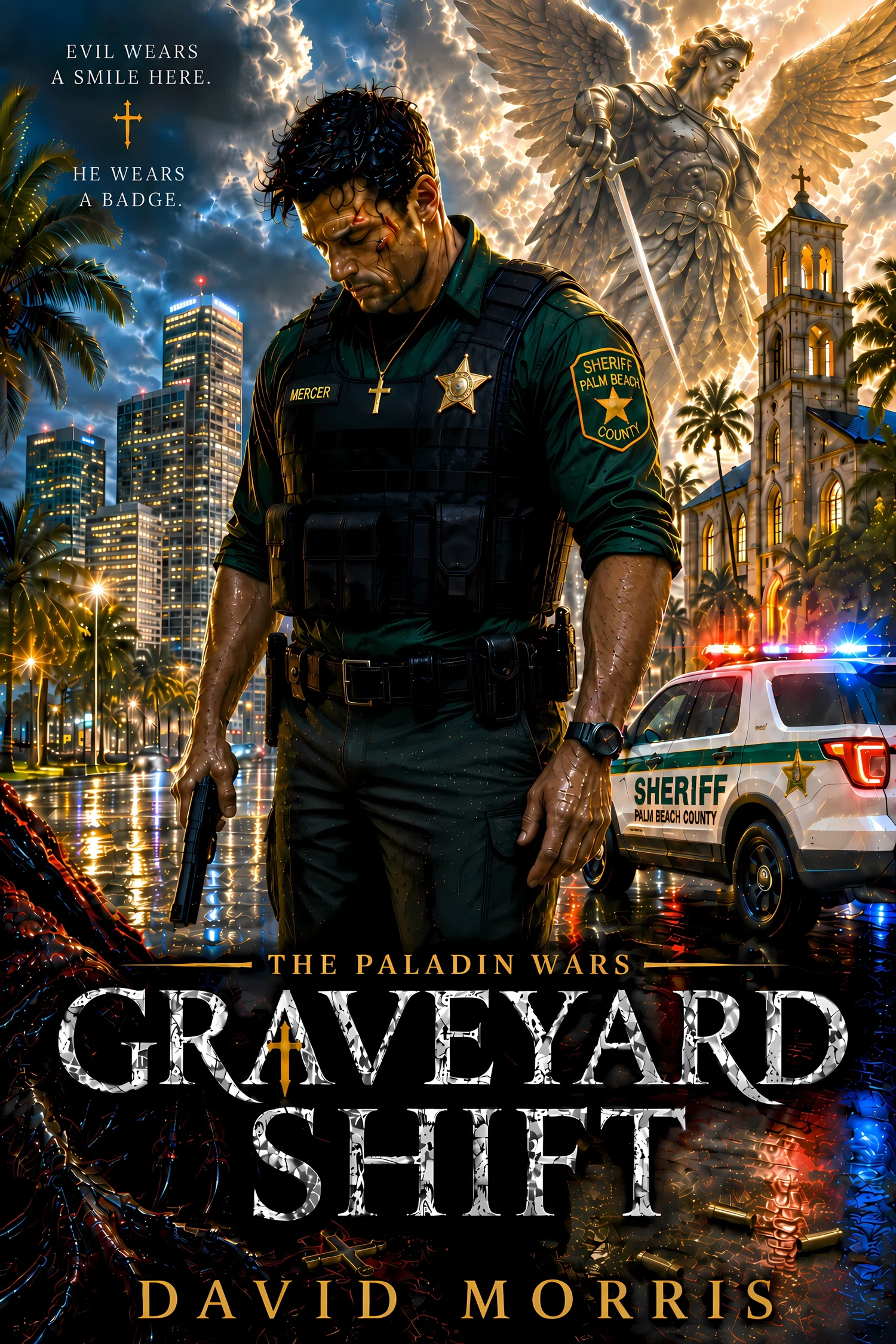
Graveyard Shift
Christian Urban Fantasy / Supernatural Police Thriller
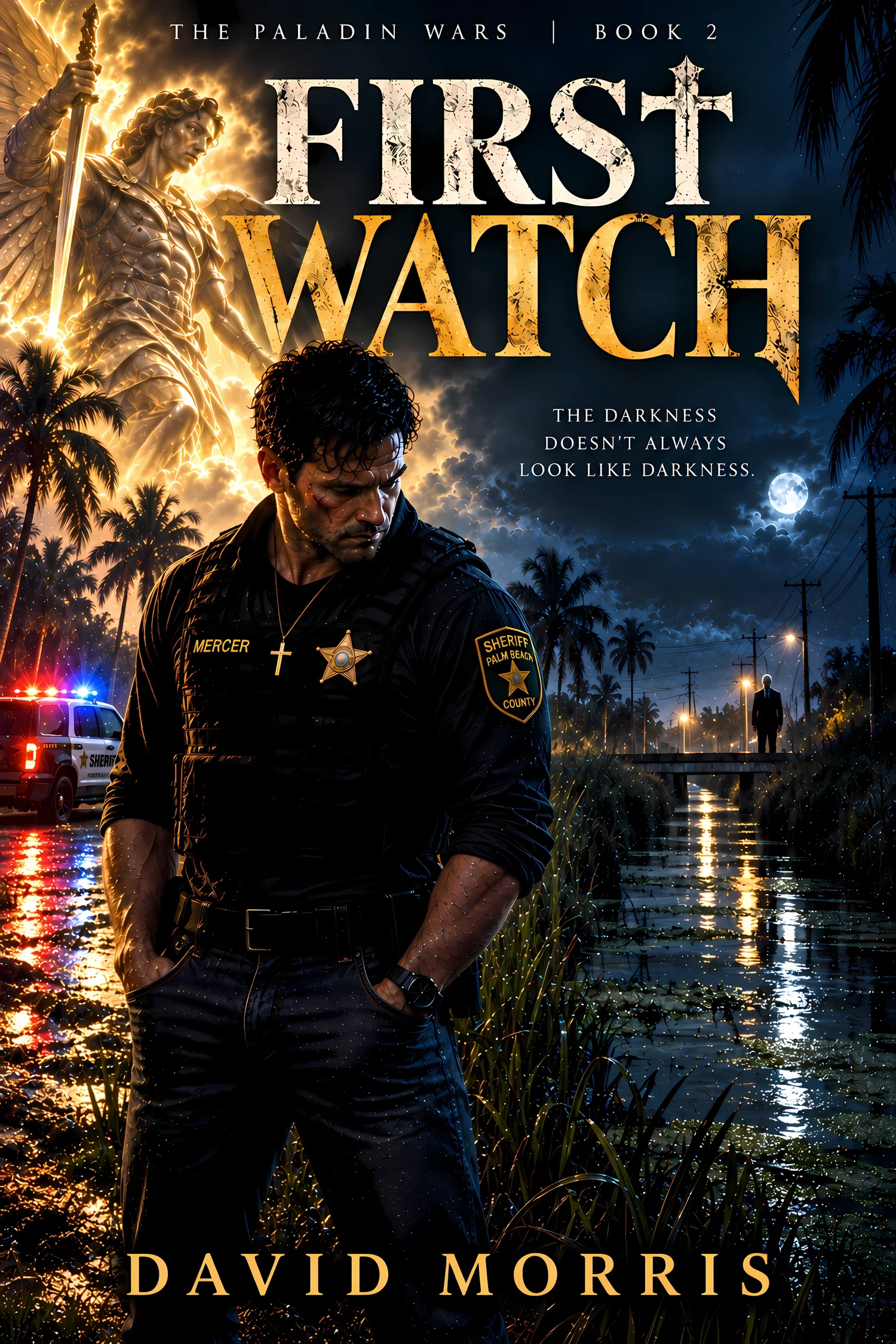
Christian Urban Fantasy / Supernatural Police Thriller
THE DEAD MAN HAS NO NAME.
by David Morris
reader promise
THE DEAD MAN HAS NO NAME.
cover copy
THE DEAD MAN HAS NO NAME.
DANIEL MERCER CAN SEE WHERE IT WENT.
Eight months after dying in the line of duty, Palm Beach County deputy Daniel Mercer is still learning what it means to be a Paladin.
The badge handles the crimes people understand.
The rest belong to him.
When a young man’s body is pulled from a canal, there is nothing to identify him.
No wallet. No records. Not even a name on the hospital band around his wrist.
But Daniel sees what the other cops can’t.
Something has been taken from the victim—and whatever took it isn’t finished.
Another body follows.
Then another.
Each victim has been stripped of more than a life. Their identities are disappearing with them, leaving Daniel hunting an enemy that doesn’t simply kill people.
It erases them.
The deeper Daniel digs, the closer the trail comes to home. Someone knows what he is. Someone has been waiting for him. And when the investigation turns against Daniel, the Paladin suddenly finds himself without a badge, without a weapon, and cut off from the people he trusts most.
Exactly where his enemy wants him.
Daniel has already learned that monsters can wear human faces.
Now he’s about to learn what happens when one knows his name.
THE FIRST TIME DANIEL MERCER FACED HELL, HE DIED.
THIS TIME, HELL INTENDS TO MAKE SURE NO ONE REMEMBERS HIM.
First Watch, Book Two of The Paladin Wars, is a gritty Christian urban fantasy thriller packed with supernatural crime, spiritual warfare, police procedural suspense, angels and demons, dark humor, found family, and a widowed father discovering that coming back from the dead was only the beginning.
Perfect for readers who love faith-driven supernatural suspense, morally complex heroes, demonic investigations, hard-edged police thrillers, and contemporary fantasy where faith has a cost and evil doesn’t always announce itself.
sample chapters
Formatted for comfortable reading on desktop and mobile.
The first fence job of the night came apart because Terrell bought gas-station coffee. He’d deny it under oath. He’d say the green Chevy cruising through the storage lot had already made us twice, or the guy in the passenger seat kept looking at the same row of units too long, or the Kessler receivership had made every cheap padlock in Palm Beach County worth watching.
All true.
The coffee still did it.
Terrell set the paper cup in the holder between us. Steam climbed through the bad lid, and every tap of the brake sent the cup rocking toward my right knee. Coffee pushed through the seam in thin brown beads and ran down the side, one drop at a time, until it hit the napkin he’d wedged under it.
“That thing’s gonna fail,” I said.
“Your faith is inspiring.”
“My faith is in Christ. My distrust is in whoever trained you to put hot liquid in a cup holder while driving surveillance.”
“It’s not surveillance if you keep narrating.”
“It’s commentary.”
“It’s evidence of a head injury.”
Eight months ago, I would’ve had a cleaner answer. Meaner. Funnier, if I was lucky and the pain meds hadn’t flattened the timing out of me. Eight months ago, Terrell and I were trying to work out whether I was crazy or resurrected or concussed. Damned, blessed, or all five before lunch. Now we were in an unmarked county car watching a storage facility off the Southern corridor, west of Haverhill, where the city lights had thinned out and the canal roads ran black between warehouse backs and drainage easements. Street Crimes had us in plain clothes. Williams had us on a Kessler receivership thread that began with stolen lawn equipment and contractor trailers. It kept widening until stripped copper, resale listings, shell leases, and a dead woman all pointed at the same row of units.
That kind of work would’ve ended with a report, two arrests, and coffee stains in the cup holder. Eight months ago, Williams had been a sergeant, and I had been a patrol deputy who still answered a radio. My last call on nights had been a storage lot too, a marine place off the water with a light on in a closed office and a child crying somewhere no camera found. Two units cleared it. Nothing inside. Nobody ever explained the crying, and the report closed the way reports close.
The storage office had closed at six, but the gate still opened for valid codes. Headlights slid through the chain-link fence in hard white bars. They crossed the roll-up doors, broke against parked box trucks, and flashed back off puddles the afternoon rain had left in the low spots. The lot sat too low for the drainage plan taped to somebody’s wall.
South Florida did that to men with site plans.
Terrell eased us past the entrance for the third time. The Chevy sat two rows in, nosed toward a unit with a blue tarp caught under the door. Every time the wind pushed under the tarp, it snapped once and lay flat again. “Passenger’s out,” Terrell said.
I had my phone up like I was ignoring him for a text. The camera caught the man stepping into the lane between units. White male. Thirties, unless hard living had stolen a decade. His black ball cap cut his face in half, and the bolt cutters rode low against his leg where the camera could still catch them. “That’s subtle.”
“Lot of criminals disappoint me on presentation.”
“You’ve been spoiled by television.”
“I’ve been spoiled by warrants.”
The man stopped at Unit C-18, looked once toward the gate, and set the cutters on the hasp. Clean enough.
Terrell picked up the radio mic from the console. “County, Street Crimes Twelve. We have an active burglary in progress at the Southern storage location. Two subjects, green Chevy SUV inside the gate. Send marked units. We’ll hold eyes.”
The dispatcher came back with the calm voice people use when their job is to keep panic out of the bloodstream. Units were en route. Patrol would take the grab. We were plainclothes, and Williams had been sharp about that since the transfer.
Observe. Preserve. Don’t turn every shadow into a foot chase. Not her exact words. Her exact words had involved my medical history, Terrell’s blood pressure, and a promise to staple both of us to a desk if we made her explain one more avoidable mess to command.
I liked Williams. I feared her stapler.
The bolt cutters bit down. Metal popped. The passenger froze, shoulders drawn up around his ears, waiting to see whether anyone had heard. Rainwater ticked from the roll-up door and ran over his shoes. He hauled the broken lock free and rolled the door up six inches. The tarp fluttered against his shoes. He bent for it.
Behind us, a marked unit turned off Southern without lights and tucked into the side road. Another rolled in from the west. Terrell didn’t move. His left hand rested at the bottom of the wheel, loose enough to look bored, ready enough that I could see the tendon stand out in his wrist.
Terrell could make patience look like restraint and threat at the same time. “You good?” he asked.
“Yeah.”
“That’s the yeah people say before they make me do paperwork.”
“I’m deeply committed to reducing your paperwork.”
“You lie different now.”
I looked at him.
He kept his eyes on the storage row. The truth sounded worse because he didn’t dress it up. I did lie different now. Less often. Less cleanly. Usually with witnesses.
“I’m good,” I said. “For this.”
Terrell gave me half a second, then keyed the mic again. “County, Twelve. Marked units are in position. Suspect one at C-18 with cutters. Driver still in the Chevy.”
The radio answered. Patrol moved.
The first deputy came through the pedestrian gap by the office, pistol down at the ready, flashlight off until he needed it. The second unit blocked the gate. The passenger saw the uniform and made a choice that lasted exactly six steps. He bolted down the row, tripped over the blue tarp, and hit the wet pavement chest-first and slid.
“Elegant,” Terrell said.
“Olympic.”
“I’m deducting for that landing, for the record.”
The driver gave up before anyone asked. He put both hands out the window and let the patrol deputy talk him backward from the Chevy. The passenger stayed face-down, cursing into rainwater, one hand pinned under his ribs, the other still reaching for a bolt cutter ten feet away because hope springs stupid. We stayed in the car until cuffs went on.
Reyes would’ve laughed at me for staying in the car and thinking I had accomplished virtue. Then he would’ve told me restraint only counted when it cost blood. Then he would’ve given me tea strong enough to strip paint and asked which sin I was proud of surviving this week. The memory came with the taste of old church air and burnt leaves that weren’t there. My scar tightened under my shirt, six fine lines pulling from sternum to ribs.
I took air through my nose and stayed where I was.
Terrell saw my hand flex against my thigh. He didn’t look down.
“You with me?”
“Yeah.”
“Here or church?”
“Here.”
“Good. I hate parking at church.”
“God heard that.”
“God knows.”
When we got out, patrol had both suspects seated on the curb. The deputy with the passenger was young, square-shouldered, and trying to sound older than his face. His name tape said RIVERA. He gave Terrell the quick up-down every uniform gives plainclothes at a scene, then recognized him a half second later.
“Boyd,” Rivera said.
“Rivera.”
“This yours?”
“Burglary’s yours. We were watching the property thread.”
Rivera looked toward me. “Mercer.”
There was a pause after my name now. Some people filled it with questions. Some filled it with the hospital rumor or the shooting or the Kessler mess. Some had seen the video nobody was supposed to have kept and knew I had been dead long enough for paperwork before I came back with scars nobody liked to discuss.
Rivera filled it with work. “You got video?”
“Phone and dash,” I said.
“Good. C-18 owner called earlier about a trailer. Might make my sergeant happy.”
“No promises that last.”
He almost smiled. The passenger on the curb spit blood into the puddle between his knees and called all of us fascists, then asked whether anyone could get him a cigarette.
Terrell looked at me. “You miss patrol?”
“Every day.”
“Liar.”
“Every third Thursday.”
We gave Rivera the quick version. Time observed. Vehicle. Two subjects. Forced entry. No pursuit by plainclothes and no force by us.
It kept going.
The call came over the radio while Terrell was spelling his last name for Rivera even though Rivera knew damn well how to spell Boyd.
“Thirteen-P, Signal seventy-nine, possible body in the canal, south side access road near the drainage structure along the C-51. Caller is a fisherman, advises unknown male floating near the bank. Fire rescue being notified.”
Rivera stopped writing.
Terrell’s eyes moved toward the canal road beyond the storage lot. Mine followed.
The C-51 ran out there in the dark, broad and black under the bridges, carrying stormwater east through a canal system men had spent a century cutting into the county. Grass clung to the bank in torn handfuls. A row of Australian pines leaned over the far edge, and the wind dragged their needles across each other with a dry rattle that cut through the radio traffic.
The storage burglary dropped away.
Terrell put his notebook in his pocket.
Rivera said, “That’s two blocks.”
“Closer than that if you cut the access road,” Terrell said.
The radio asked for the nearest unit. Rivera lifted his mic.
Terrell beat him to it.
“County, Street Crimes Twelve. We’re at the storage location with units on scene. We can respond to the canal and hold until marked patrol arrives.”
Dispatch copied.
Rivera looked relieved and annoyed at the same time. “I’ve got two in custody.”
“Stay with your people,” Terrell said.
We jogged back to the car.
“You said we were reducing paperwork,” I said.
“I said you lie different now.”
He drove.
The access road had no romance to it. Crushed shell gave way to busted asphalt where grass worked through the cracks. The rain had filled the ruts deep enough that Terrell slowed to keep from throwing water over the hood. Headlights caught the pale backs of signs warning people not to swim where nobody with sense would’ve put a toe in anyway.
The fisherman stood beside a white pickup with both doors open. His rod lay on the roof, line still threaded, lure tapping the windshield every time the wind pushed it. He was older, sun-carved, with a towel wrapped around one hand. His other hand pointed at the water and refused to come down. Terrell stopped short of him, angled the car to light the bank, and left the headlights on. “Stay put,” he told me.
“Funny.”
“I’m serious.”
“That’s worse.”
“Daniel.” He only used my first name on calls when he meant partner instead of deputy. I stayed until he had the fisherman talking. Then I got out slower than I wanted to.
Terrell noticed and let me have it.
Headlight glare skidded across the canal, broke on wind chop, and caught on a pale shape pinned in the weeds along the near bank.
Male. Face down. His shirt ballooned with water. One shoe was gone. The remaining foot rocked with the current, toe knocking against a half-submerged branch.
The fisherman kept talking too fast. “I thought it was trash. Like a bag. You see bags all the time. Then the hand came up. I didn’t touch him. I swear to God, I didn’t touch anything. I used the rod to keep him from going under the culvert, but I didn’t touch him.”
“You did fine,” Terrell said. “What’s your name?”
“Eddie. Edward Mars.”
“Mr. Mars, I’m Detective Boyd. That’s Detective Mercer. Fire rescue is coming. Deputies are coming. I need you to stand by your truck for me.”
“Is he dead?”
Terrell didn’t answer the question he couldn’t answer from ten yards and a canal bank.
“Stand by your truck.”
The man obeyed because Terrell had that voice, built for getting people through the next ten seconds without letting them vote on each one.
I walked toward the bank.
“Mercer,” Terrell said.
“I know.”
“Don’t make me say the part you’re about to hate.”
I stopped two strides from the mud lip. “We hold the scene. We don’t recover. We don’t trample the bank. We don’t decide cause from headlights, and I don’t go swimming.”
“That last part was my favorite.”
The bank dipped hard at the edge, cut under by runoff. One wrong step and a man could slide in up to the waist before he had time to swear. I crouched where the grass still held and took out my flashlight.
The beam crossed the back of the dead man’s head. Short dark hair lay flat against his skull. His hands drifted open in the weeds, pale under the water, and a black band hugged one wrist. No wallet showed in the turned pockets. No phone. No keys on the belt.
Ordinary. Ugly. Then the scar under my shirt went cold. Pain belonged to the body. Cold came from somewhere else and left my body trying to decide whether it was allowed to refuse.
I shut my eyes. Lord, keep me honest.
When I opened them, the canal was still a canal. Brown-black water moved east. Weeds bent under the flow. Headlights burned on wet grass while Terrell talked to the fisherman and a marked unit bounced down the access road behind us.
And the dead man had threads lifting from him.
They weren’t silver. Silver I knew. Silver answered like struck metal and prayer, like a bell you felt in the bones before the ear caught up. These were dark where they left the body and pale where they thinned, not black, not white, not any color the eye had business naming. They unspooled from the dead man’s shoulders and mouth and hands in strands so fine the wind should’ve snapped them. The wind didn’t touch them. The current didn’t drag them. They rose two feet above the canal, turned west against the moving water, and drew themselves toward the dark beyond the storage lights.
Like a signature being pulled off wet paper.
No.
That was too neat. Too poetic. Too sure.
Reyes’s voice cut through memory with no mercy at all.
Sight is not understanding.
I tightened my fingers around the flashlight until the knurling bit my palm.
“Daniel,” Terrell said from behind me.
I didn’t turn.
“Yeah.”
“You seeing what I’m not?”
Eight months ago, I would’ve kept the impossible behind my teeth and called that protection.
“Name loss,” I said.
The words came out before I knew I trusted them.
Terrell stepped beside me, careful of the bank. He didn’t look at me first. He looked where I looked, because that was Terrell. Ordinary facts first. Impossible facts second. Feelings somewhere after lunch if the schedule allowed. “Tell me what you can.”
“I can’t.”
“Then start with the part that sounds wrong.”
“It’s leaving him.”
“What is?”
The marked unit rolled up behind us. Red and blue light washed across the canal without siren, color breaking apart on the water. The threads didn’t take the light. They didn’t throw it back. They moved through it, westward, untouched.
“His name,” I said.
Terrell was quiet for one breath.
“Like Kessler?”
“No.”
That answer came fast. Too fast.
I forced my mouth shut and made myself look again.
Vorath had fed through covenant and appetite. The Alcazar had held its dead under stone, promise, family money, and a hundred years of men telling themselves the price was manageable. That wrongness had roots.
This wasn’t rooted. This was collection.
The dead man’s threads tightened. One snapped free from his hand and slid west so fast I lost it past the edge of the headlights. Another peeled away from his mouth. His lips moved with the water. He wasn’t talking and it didn’t look like any miracle I’d ever seen.
Dead was dead.
Fire rescue arrived with an engine and a rescue unit, tires cracking shell under the load. Deputies started setting cones across the access road. Rivera came over the radio to say his burglary suspects were secure and his sergeant was en route. The fisherman sat on his tailgate with the towel still wrapped around his hand while a deputy took his statement.
Deputies and fire rescue built the scene around the body one job at a time. Tape first. Then lights, gloves, and questions.
Terrell made calls. He gave our position and our reason for being close. The storage burglary connection still wasn’t a connection yet, but it moved CSI and pushed the call toward the death-investigation channel. He didn’t say my partner sees the victim’s name leaving the body and heading west.
He kept his report clean and his body between me and the nearest bad idea.
I backed away from the bank before anyone had to tell me twice. The fire lieutenant reached the edge and swore under his breath. He had two firefighters stage a ladder flat near the bank so nobody trusted the mud. A deputy walked a second line of tape farther out after the first one sagged in the wet grass. Mosquitoes found everybody. The canal kept moving.
Terrell came back to me with his notebook open.
“No wallet,” he said.
“Pockets turned.”
“Fisherman didn’t touch the body with his hands. Used the rod to keep him from drifting under the structure.”
“That’ll make recovery fun.”
“ME’s responding. CSI’s coming. Violent Crimes supervisor got notified because nobody likes a body with empty pockets in a canal.”
“Imagine that.”
He looked past me to the water. “Still happening?”
I turned. One thread remained.
It came from the dead man’s left hand, where the fingers floated open and closed against the weeds. It stretched west, thinner than fishing line, and pulsed once.
The black band on his wrist shifted when the water rolled him half an inch. Didn’t look like a watch. Maybe a hospital band, if we could get that lucky.
“Left wrist,” I said.
Terrell clicked his pen once. “I see it.”
“Hospital band.”
“I see that too.”
“Can you read it?”
“Not from here.”
The last thread tightened. The dead man’s hand lifted with it, just enough that water streamed off the fingers. For half a second, the hand looked like it was reaching after the thing being taken.
Then the thread went west. The hand dropped.
After that, all I could see was the body.
I hated the relief that followed. Hated it down to the root. The impossible left, and some part of me wanted to call that safer even with a dead man in the canal and his name dragged away into the dark.
Terrell watched my face. “Gone?”
“Gone.”
“Direction?”
“West.”
He wrote one word in the notebook.
He didn’t write name or thread. He wrote west.
That was why I loved him.
That was why lying to him had almost killed us both.
The rescue crew set up for recovery. A deputy asked us to move back another ten feet. Terrell did. I followed because my partner had already won one argument tonight and deserved a streak.
Williams called before the body came out.
Terrell put her on speaker without asking me.
“Tell me nobody got creative,” she said.
“Nobody got creative,” Terrell said.
“That answer was too fast.”
“Burglary suspects in custody at the storage lot. We responded to the canal because we were close and patrol was tied up with our two.”
“Mercer?”
“I’m here,” I said.
“Did you get wet?”
“No.”
“Did you touch anything?”
“No.”
“Did you see anything that will ruin my night?”
Terrell looked at me.
The old answer pressed at my teeth. No. Nothing. Just a body. Just bad luck. Just another dead man in a county full of canals and secrets.
I watched fire rescue hook the body with a pole and guide him toward the ladder. Water sheeted off his shirt. The hospital band flashed white and blank under the lights.
Blank.
No printed name. No barcode. No patient number.
The ink hadn’t washed off. The band had never held it.
“Yes,” I said.
Williams didn’t sigh. Williams only did that when she wanted you to know exactly how much restraint she was spending.
“How bad?”
I looked west. Past the storage units. Past Southern. Past the dark roofs and county roads and all the places the Kessler money had touched before anyone learned to call it rot.
“I don’t know yet.”
Terrell’s pen stopped moving.
Williams said, “That’s new.”
“I’m trying it out.”
“Keep trying. Boyd, keep him out of the water. Mercer, don’t mistake ignorance for permission.”
The line clicked dead. Terrell pocketed the phone.
“She’s warming up to you,” he said.
“I felt cherished.”
“That’s the stapler.”
They brought the dead man onto the bank at 11:42 p.m.
He was younger than the water had made him look. Late twenties. Old enough to have built a life, young enough that somebody might still have his school pictures in a hallway. The hospital band clung to his wrist. When the firefighter turned it toward the light, the strip showed a blank white field where the name should’ve been.
Not even a smudge. Not torn. Like the man had no history left at all.
The deputy beside the ladder muttered, “What the hell?”
Nobody answered him.
The canal road filled one unit at a time. Deputies took the road. Firefighters held the bank. Crime scene opened cases beside the medical examiner’s investigator. Everyone had a job except the man on the grass. Cameras rose. Gloves changed. A measuring tape stretched across wet grass and snapped back when the wind caught it. The fisherman watched from his tailgate and pressed the towel against his hand until his knuckles paled.
Terrell stood beside me, close enough that his sleeve brushed mine.
“You said west,” he said.
“Yeah.”
“Toward what?”
I could’ve said I didn’t know. It would’ve been true.
I could’ve said Kessler money had left fingerprints all over the county. Old school routes. Receivership files. Storage units where people learned to turn a name into a line on a form.
Also true.
The scar under my shirt gave one cold pull, straight through the ribs. I looked west. “Toward whoever’s collecting.”
The porch light clicked off at six-thirteen, and I was still standing in the kitchen with canal mud dried along one boot.
From behind Abby’s bedroom door came three hard yanks and one wooden shriek. Then silence, the kind that meant she had dropped something important and was deciding whether adults needed to know. The air conditioner kicked on before the kitchen got warm. I was out of step, badge on the counter and one hand braced on the sink.
I should’ve taken the boots off outside.
Rachel would’ve made me do it before I touched the doorknob. She’d had a whole system for it, one finger pointed at the porch mat, one look aimed at whatever I had tracked across her clean floor. I used to pretend the lecture annoyed me. Then she died, and the mat stayed by the door, and some mornings I stood on it longer than the dirt required because nobody was there to tell me I was doing it wrong.
That morning I had tracked mud past the mat and across the floor Rachel used to guard like it was jurisdictional.
Deb came into the kitchen carrying a basket of laundry against one hip and stopped with the calm of a woman who had raised children, buried a daughter, and learned exactly how much judgment a man could take before coffee.
“Shoes,” she said.
“I know.”
“Do you?”
“I’m standing in remorse.”
“You’re standing in dried canal.”
“Adjacent concepts.”
She set the basket on the chair Rachel used to claim when she paid bills. Nobody called it Rachel’s chair. We just kept finding reasons to use it. Abby spread math homework there when she wanted help without asking for company, and Deb folded towels on the seat when the dryer finished before she was ready for bed. Leaving it empty would’ve made the room worse.
I bent to unlace the boots and felt the scars pull.
The old silver branches pulled from sternum to ribs. Most days they passed for healed damage. After the canal, after the cold came through me and a dead man’s name went west, they ached under the shirt like wire being tuned.
Deb saw me pause.
“Sit down before you fall down.”
“I didn’t fall at the canal.”
“Daniel.”
“I’m fine.”
“Then be fine in a chair.”
I sat.
She didn’t gloat. Deb didn’t need to. She had an economy of victory that made Williams look chatty. She took the boots by the tongues, carried them to the back door, and set them outside on the concrete step. Then she came back, washed her hands, and put a pan on the stove because Abby still had school.
Butter ran toward the cool side of the pan. Deb chased it back with a spatula, cracked two eggs, and broke both yolks before they could set. Abby hated runny yellow on school days and loved it on Saturdays, a distinction no grown man could understand and no wise one questioned.
“You came in after three,” Deb said.
“A little after.”
“Terrell texted.”
“Traitor.”
“He said you were upright, dry, and irritating.”
“Accurate witness.”
“He also said there was a body.”
The faucet dripped once behind me. I had tightened that handle twice already. It still leaked when the house settled, one drop at a time. I reached back and turned the handle until my fingers hurt.
“There was a body,” I said.
“One of yours?”
“No.”
She glanced over her shoulder.
“Not ours to own,” I said. “We were close. Held the scene. Proper channel has it.”
“You sound like you’re answering Lena.”
“Practice keeps me alive.”
“Truth keeps you alive. Practice keeps you employed.”
That landed close enough that I pretended to inspect the mud drying in the seams of my boots through the back door glass.
Abby came in with one sock on and her uniform shirt untucked. Half her hair had accepted the brush. The other half stood out from her head like she had negotiated separate peace terms with it.
“I can’t find my other shoe,” she said.
“Good morning to you too,” I said.
“Morning. Shoe.”
“Which one?”
“The one I’m not wearing.”
“Specific. Useful. Strong police work.”
She gave me Rachel’s look. Not the big one. The small version Rachel used when she wanted me to hear myself and suffer privately.
Deb pointed the spatula toward the hallway. “Check under the bed.”
“I did.”
“Check under the bed like you want to find it, not like you want to prove it isn’t there.”
Abby left at a run that was supposed to be walking because the rule said no running in the house. Her single sock slapped tile, then carpet, then tile again.
I looked at Deb. “That was a very specific legal distinction.”
“I’ve met your daughter.”
“My daughter?”
“When she’s missing shoes before breakfast, yes.”
Abby shouted from the bedroom, “Found it!”
Deb turned back to the eggs. “Miracles continue.”
I smiled because it was allowed there, in the thin strip between the sink and the table, before the phone rang or the scar pulled or the dead returned without names. Deb slid Abby’s lunchbox away from the stove, and light caught on its glittered edge. Rachel had bought the thing against my advice, all sparkle and no structural integrity. I had replaced the zipper twice and still found glitter in the car.
Abby came back with both shoes on and her hair still divided between civilization and war.
“Sit,” Deb said.
“I’m not hungry.”
“Sit hungry.”
Abby sat.
Deb put eggs and toast in front of her. Abby took the toast first and used it to push egg into a shape she could live with. She had done that since she was five. Rachel used to say it was fine motor development. I used to say our child was building defensive works against breakfast. Both of us had been right.
I reached for my coffee. My hand shook once before it got there.
Not much. Enough.
Abby saw it.
Nine wasn’t eight. Nine saw the shake and didn’t ask about the coffee.
“Does it hurt today?” she asked.
Deb’s spatula stopped against the pan.
I set the mug down. “What does?”
Abby looked at my chest, then at my face, annoyed that I had made her say the thing both of us knew.
“The lines.”
My shirt was buttoned. The scars weren’t showing. Didn’t matter. Abby had learned the map anyway: the bathroom cabinet I opened after hard shifts, the drawer I closed too fast, the half-second delay before I laughed because pain had to pass first.
“A little,” I said.
“Because of work?”
“Because I got home late.”
Deb moved the pan off the burner.
Abby chewed the corner of her toast and thought that over with all the care of a judge who still needed help opening juice boxes. “Late doesn’t make marks.”
“No,” I said. “It doesn’t.”
“Was there a bad guy?”
The easy lie was yes.
I could’ve said yes. She understood bad guys. Bad guys were in cartoons, school lockdown drills, the prayers Deb didn’t think she heard from the hallway. A bad guy made the world ugly and simple. A bad guy let me be the thing that stood between.
“There was a man who died,” I said. “We don’t know why yet.”
Abby’s toast lowered to the plate. “Did he have a kid?”
“I don’t know.”
“Somebody has to know.”
“We’re going to try to find them.”
“You and Uncle Terrell?”
“And other deputies. The right people.”
Deb looked at me then, and the look had no heat in it. That made it worse. She had heard the careful shape of the answer, all the true pieces set where I wanted them: the right people, proper channel, not ours to own.
Abby accepted it because she was nine and breakfast was getting cold. She cut the egg into smaller pieces with the edge of her fork.
“If he has a kid, you should tell them gently.”
“Yeah,” I said. “We should.”
“Not like the lady from the hospital.”
The kitchen changed.
Not much. The toaster gave its little metal tick as it cooled. A school bus groaned somewhere down the block. Deb took the pan to the sink and set it down without a sound.
Abby didn’t look at any of us. She kept cutting the egg smaller than she needed to. The lady from the hospital had worn blue scrubs and a badge flipped backward on a lanyard. She had stood outside my room after I woke up and asked Deb whether Abby understood what happened, whether Abby needed counseling, whether Abby knew her father had been clinically dead. Abby had been sitting where she could hear every word.
People loved to ask whether children understood. They rarely asked what adults had already made them carry.
“No,” I said. “Not like that.”
Abby nodded once.
Deb put a glass of water by my elbow and two pills beside it.
“Eat first,” she said.
“I’m not hungry.”
“Sit hungry.”
Abby looked up. “That’s what she told me.”
“House policy,” Deb said.
I took a piece of toast because losing twice before seven in the morning seemed excessive.
My phone lit on the counter. Terrell.
I didn’t reach fast, and that told them I wanted to. Deb saw. Abby saw too, which meant I had failed twice in one motion.
“You can answer,” Deb said.
“It’s breakfast.”
“It’s also work.”
“Work can wait five minutes.”
The phone went dark.
Deb leaned back against the counter. “That was an announcement.”
“What was?”
“Work can wait five minutes.”
“That’s a sentence.”
“It’s you telling us what the room needs to agree with.”
I had a good answer. It involved responsible boundaries, family priority, and the fact that I was sitting in my own kitchen with a piece of toast instead of chasing a dead man’s stolen name across the county before the sun had cleared the trees.
It would’ve sounded excellent. It would’ve been crap.
Abby watched me over her orange juice.
I picked up the phone, opened Terrell’s text, and read it where Deb could see my face.
ME got transport. No ID. Band blank in photos too. Williams wants us in at ten, not eight. Sleep if your brand allows it.
“Ten,” I said.
Deb’s shoulders eased a fraction. Abby went back to the egg.
“See?” I said. “Boundaries.”
“Terrell set the boundary,” Deb said.
“I participated by receiving it.”
“Heroic.”
Abby smiled into her juice.
The smile did more damage than the scars. It always did. Pain had rules. Abby smiled with toast crumbs on her uniform shirt, and I wanted to say yes to anything that kept that look on her face.
I drank the water and took the pills. They went down badly. One caught halfway and made me cough until the scar lines tugged hot under my shirt.
Abby flinched. I put the glass down carefully.
“I’m okay.”
“You say that a lot.”
“Occupational hazard.”
“What does occupational mean?”
“Work-related.”
“So lying is work-related?”
Deb turned away, but not fast enough to hide her mouth.
“I walked into that,” I said.
“Yes,” Deb said.
Abby pushed her plate away. “You tell people things so they don’t get scared.”
I looked at her.
She had Rachel’s eyes, which was unfair before coffee and probably illegal under several state statutes. When the sun caught them, I had to look away first. No nine-year-old who still needed reminders to brush the back teeth should’ve been able to do that.
“Sometimes,” I said.
“Mom did that.”
Deb’s hand found the counter behind her.
I didn’t move. If I moved too fast, Abby would know she’d struck bone.
“Yeah,” I said. “She did.”
“But she told me when shots were scary.”
Rachel had. During vaccine appointments, summer storms, and the first active-shooter drill that sent Abby home pale and furious, Rachel had never lied by saying scary things weren’t scary. She’d narrowed the truth until Abby could hold it.
I had forgotten that too often.
“She was better at that than me,” I said.
“You can practice.”
Deb made a small sound at the sink, not quite a laugh and not safe enough to name.
“I can,” I said.
Abby studied my chest again, not where the scars showed, but where she knew they lived.
“Then practice with the lines.”
Cold air pushed through the vent over the table. Outside, a neighbor’s sprinkler ticked across a lawn already wet from rain, and somewhere down the street a child protested the existence of school with legal force.
I could’ve told Abby the scars were from the night I died. She had the truth in pieces: hurt doing my job, people praying, Dad coming home different while everyone treated different like a schedule problem. The part about first and last wasn’t one of the pieces. Neither was the commission burning under my skin. Neither was the way her prayer and Rachel’s prayer lived in me like two hands pulling opposite directions.
Not yet. I hoped not ever like that.
“They hurt when I forget what they’re for,” I said.
Abby frowned. “What are they for?”
Deb didn’t save me. She wouldn’t.
“To remind me I don’t belong only to me.”
Abby thought about that, then looked down at her uniform shirt and picked an invisible crumb off the collar. “Like being a dad.”
The answer hit clean.
“Yeah,” I said. “Like being a dad.”
“And a deputy.”
“Yeah.”
“And God’s?”
Abby said it like she had put it beside the toast and the pills and the lunchbox with its failing zipper, then waited for her father to answer.
“Yeah,” I said. “And God’s.”
She nodded, then held out her plate.
“Can I be done?”
Deb took the plate. “Brush teeth. Both shoes stay on. Hair gets finished before you try the door.”
Abby slid from the chair and leaned into my side on her way past. Not a hug. A drive-by contact, shoulder to arm, quick enough to deny if anyone made it sentimental. Her hair brushed my sleeve, and the scar lines eased by a fraction I didn’t deserve.
At the hallway, she stopped.
“Dad?”
“Yeah, baby?”
“Do the lines hurt when you lie?”
Deb closed her eyes.
The phone on the counter lit again. Terrell this time, calling.
I let it ring once. Twice.
Abby waited. The honest answer wasn’t small. So I made it smaller.
“They should,” I said.
Abby took that in, nodded like I had given her a piece that fit, and went to brush her teeth.
I answered the phone on the fourth ring.
Terrell didn’t say hello. “You awake?”
“Define awake.”
“Williams moved it back to nine-thirty. ME got a hit that’s not a hit.”
Deb set Abby’s plate in the sink and looked at me. I didn’t cover the phone.
“How does that work?” I asked.
“Hospital band stock traces to a discharge batch, but the patient field is blank in their system too. Not deleted. Blank. Like nobody entered him.”
The kitchen light buzzed once overhead. Abby’s toothbrush scraped in the bathroom. Deb picked up Rachel’s chair and moved it back under the table with both hands.
“That’s not a hit,” I said.
“That’s what I said. Williams said bring coffee and whatever your church damage calls restraint.”
“My church damage has standards.”
“Good. Put shoes on that don’t have canal on them.”
He hung up. I lowered the phone.
Deb wiped the counter with a cloth washed thin at the corners. She worked around the pills, the glass, and the ring Abby’s juice had left. Rachel used to wipe counters that way, cleaning up after us without making anyone feel like the mess.
“Nine-thirty?” Deb asked.
“Nine-thirty.”
“You need twenty minutes flat.”
“I can do fifteen.”
“You need twenty minutes flat,” she said again.
I nodded.
That was asking, or close enough for a man still learning the shape.
Deb handed me a clean shirt from the laundry basket. She must have folded it before I came in, because it was warm from the dryer. I held it until my fingers stopped aching.
“Daniel.”
“Yeah.”
“Don’t turn not knowing into a place to hide.”
I looked toward the hallway where Abby was mangling a song around toothpaste.
“I’m trying.”
“I know.” Deb picked up the basket. “Try out loud.”
I stood there with the clean shirt in my hands while Abby spat toothpaste, while the clock over the stove ticked toward school, while the dead man from the canal lay in a county cooler without a name.
Out loud, then.
Williams had taken the good chair.
She did that when she wanted nobody in the room to forget who had survived command staff before breakfast. The good chair sat at the end of the Street Crimes table with its back to the wall and a view of both doors. It rolled crooked because one wheel caught every third turn. Williams had learned the catch and used it anyway, nudging the chair with her heel until everyone shifted around her.
Terrell and I took the side nobody wanted, under the vent that cut too cold and rattled when the compressor kicked. My clean shirt from Deb had lost its dryer warmth on the drive in. Cold worked through the cotton until the scar lines tightened.
I kept my hands flat on the table.
Terrell saw it and slid a coffee toward me without looking, the cup wrapped in three napkins and sealed under a lid that actually fit.
“Progress,” I said.
“I can learn.”
“Terrifying.”
“For both of us.”
Williams set a folder on the table with two fingers, flat enough that the sound barely carried.
“Before anyone gets inspired,” she said, “Street Crimes doesn’t own the body from last night.”
“Good morning to you too,” Terrell said.
“It was. Then I opened my email.”
“Never do that.”
“I keep hoping the county will stop operating while I sleep.”
“Any luck?”
“None.” She looked at me. “Mercer, what did you put in the report?”
“That we were working the receivership property thread, heard the canal call, and held the scene until the right people got there.”
“And why are you still attached?”
“Because the property thread may touch location and pattern.”
Terrell sipped his coffee. “He’s been practicing.”
“I can tell. It sounds expensive.” Williams opened the folder and turned the first page toward us. “ME took custody at oh-one-thirteen. Male, late twenties to mid-thirties. No wallet. No phone. Pockets turned. No prints in AFIS as of this morning. Dental pending. DNA not useful today. The hospital band is the problem.”
The photocopy showed the dead man’s wrist under bright morgue light. Water had swollen the skin until the band dug in. The white field where a name should’ve lived sat blank as printer paper.
I kept my eyes on the photo because looking away felt like a lie.
Terrell leaned forward. “Batch trace?”
“St. Mary’s outpatient discharge stock. Three boxes shipped six weeks ago. Their system has the band range. The patient field tied to this band is blank.”
“Blank deleted?”
“Blank blank.”
“Audit log?”
“No deletion. No amendment. No misspelled entry. No duplicate patient. Their records supervisor said the field was never populated.”
Terrell’s pen moved once, then stopped. “That can’t happen.”
“She said the same thing.”
“Who had access?”
“Everybody who should have access and nobody who admits to touching this record.”
He looked at me then. Not for an answer. For the border between answer and guess.
The wrong part of me wanted to step over it.
I could still see the last thread pulling west, the dead hand lifting half an inch from the weeds as if name had mass. I could still hear Abby asking whether the lines hurt when I lied. The boardroom cold ran over both memories until they sat together whether I wanted them there or not.
“I saw it leave him,” I said.
Williams’s face didn’t change. I could give her the impossible in plain English, and she’d still finish the meeting already on her calendar.
“What do you mean by it?” she asked.
“His name.”
“Give me the version I can use before lunch.”
“I can’t.”
“Then don’t spend it like evidence.”
Terrell clicked his pen once. “Direction was west.”
Williams looked at him.
He held up one hand. “Not as evidence. As a search question. Canal current goes east. Whatever he saw went west. The body was west of Haverhill. The storage units are right there. Kessler receivership units are in the same operating lane. We map Kessler assets west of the canal and see whether any dead-end records touch St. Mary’s.”
“That,” Williams said, “is a sentence I can survive.”
“Thank you.”
“Don’t get sentimental.”
“I wouldn’t.”
“You absolutely would, but later.” She tapped the photo. “Violent Crimes is primary if this becomes homicide. ME is primary on cause. We assist on receivership/property/fence overlap until somebody tells me to stop. If somebody tells me to stop, I want enough clean paper to argue.”
Clean paper.
People trusted the phrase because it sounded dull, and dull sounded safe. Kessler money had passed through foundations, leases, school programs, and hotel rooms where people disappeared. Nobody had to raise a voice when enough people were willing to sign, stamp, and file the proof where nobody had to look at the face.
“Mercer.”
I blinked. Williams hadn’t raised her voice.
“I asked whether you can work this without making the answer arrive before the facts.”
“Yes.”
Terrell made a small noise into his coffee.
I cut him a look. He didn’t care. Williams waited.
“I can try,” I said.
“Better. Terrible, but better.” She took the photo back. “ME liaison at ten-fifteen. Records after. I want the storage warrants clean before end of shift, and I want every Kessler touchpoint on a board that makes sense to people who don’t attend your church.”
“I don’t attend my church,” Terrell said.
“God continues to be merciful.”
“That’s what I keep saying.”
The vent rattled above us. Williams closed the folder and stood. The bad wheel on the chair caught, skipped, and hit the table leg.
She pointed at me before I could smile.
“No.”
“I didn’t say anything.”
“Your face did.”
“I’ll discipline it.”
“Start now.”
She left us with the folder, the cold vent, and the first dead man who had no name.
Terrell waited until her door shut. Then he turned his notebook around.
He had drawn a line across the page and marked it with Haverhill, Southern, the canal access road, and the storage property. West of that, he had written KESSLER RECEIVERSHIP ASSETS in block letters that dented the page.
“You were doing that while she yelled at us?” I asked.
“She yelled at you. I was present for contrast.”
“That’s friendship.”
“That’s documentation.”
I tapped the word west. “You’re taking it seriously.”
“I’m taking you seriously. There’s a difference, and your ego needs to learn it.”
“My ego has had a rough year.”
“Your ego died for six minutes and came back with a badge. It can take notes.”
He pushed the notebook closer. “Give me the canal again. Plain.”
“I didn’t use poetry.”
“You said a man’s name left his body.”
“That’s not poetry. That’s Tuesday.”
“Daniel.”
I looked at the map again. Lines. Roads. Places a person could drive in ten minutes if lights favored him. Places a person could hide a trailer, stage stolen equipment, move boxes from a unit into a van and call it salvage.
“The threads pulled west,” I said. “Against current. Against wind. They came from his mouth, hands, shoulders. Not silver. Not the way the mark answers. More like removal than binding.”
“Removal from what?”
“From him.”
“Plain, Daniel.”
“That’s the least poetic version.”
Terrell wrote removal, then underlined it once. “Could he have been alive when it started?”
The question hit harder than I liked.
“I don’t know.”
“Good. Hold that.”
“You enjoy telling me I don’t know.”
“I enjoy it less than I used to. That should worry you.”
My phone lit against the table. Unknown number. Williams’s desk phone rang through the wall. Terrell’s screen followed with a county number.
He looked at his screen. “That was fast.”
Williams opened her office door. “Both of you. Now.”
The ME liaison wasn’t in the building. She was on speaker, and from the sound behind her, she was walking somewhere with hard floors and bad acoustics.
“I’ve got a second body,” she said.
Williams shut the office door.
Terrell stood with his pad in one hand. I stayed near the file cabinet. Three people, Williams’s desk, and the second body on speaker filled the room wall to wall.
“Where?” Williams asked.
“Not your scene. Found two nights ago in a drainage cut north of Forest Hill. Unincorporated. Male, probably forties. Initially treated as overdose or exposure pending tox. No ID. Prints came back no record. That part didn’t trip alarms.”
“What tripped them?”
“Hospital band.”
Terrell looked at me. I didn’t move.
The liaison kept walking. A door opened on her end, then closed. Her voice flattened once the echo dropped. “Blank patient field. Same St. Mary’s discharge stock. Different batch range. No deletion record. No patient tie.”
Williams put one hand on the back of her chair. “Cause?”
“Undetermined. No obvious trauma. Lungs wet, but not enough for drowning. Tox pending. He has old surgical scars, malnutrition markers, and a healed fracture in the left ulna. If you want my personal read, he lived rough for a while. If you want my official read, I need labs.”
“I want both. Send the prelim.”
“Already did. That’s why I’m calling. There may be a third.”
No one moved.
Terrell’s fingers stopped on the page. Williams’s hand stilled on the chair. I pressed my thumb against the seam of my scar through the shirt before I could stop myself.
“May be?” Williams asked.
“Female, late twenties to thirties. Found last week behind a closed clinic property off Military. No ID. Initial entry in the system had her as Jane Doe pending prints. I remembered the blank band after your canal case came through, went back, and asked the tech to pull photos. Her wrist was bare when she arrived, but there was a tan line.”
“A tan line.”
“Medical band width. New. Sharp edges.”
Terrell wrote female, clinic, Military, no band.
“Where is she now?” Williams asked.
“Still with us. No next of kin. No prints. Dental pending.”
“Pull every image and send them to me. Now.”
“Already sending. Lieutenant, one more thing.”
Williams hated that phrase. Her shoulders settled.
“Let’s have it.”
“The woman had a locket. Cheap. Gold plate. No photos inside. But the inside was worn where photos had been.”
“Chain of custody?”
“Intact. It’s in property.”
“Then send the property sheet.”
“Done.”
The call ended.
For four seconds nobody spoke. Terrell wrote the last note. Williams moved to her desk and opened the email as soon as the screen came up, jabbing the mouse into a double click.
“Mercer,” she said.
“I know.”
“Then keep that answer close today.”
“I don’t know.”
“Boyd?”
“Canal and Forest Hill both tie to blank St. Mary’s stock. Military depends on the parcel. I need the clinic name, ownership, and anybody from the Kessler side who touched those locations.”
“Go.”
He left before she finished the sentence.
I stayed.
Williams didn’t look up from the email. “Why are you still in my doorway?”
“Because if I leave, I’m going to run ahead of him.”
“That was honest.”
“Deb told me to try out loud.”
Williams stopped moving the mouse. “Deb is terrifying. Tell her I said thank you.”
“Absolutely not.”
She sat back. The photo opened on her screen. I saw only a slice of it from the doorway: a woman’s wrist, pale where a band had covered it, and the locket bagged beside her property number.
“You saw direction on the canal body,” Williams said.
“Yes.”
“Did you see it on the others?”
“I wasn’t there.”
“Could you?”
“I don’t know.”
“Do you want to?”
She didn’t look away from the screen. She didn’t have to. She knew what the question did to me.
I wanted to stand over the second body and see if the last pieces had gone west. I wanted to go to the clinic property and put my hand against a wall until the hidden war showed me where to aim. I wanted the name of the thing doing this badly enough that my fingers moved toward the door.
“Yes,” I said.
“That’s why you’re going with Boyd and not alone.”
“He left.”
“He went twenty feet to the conference room, Daniel. Don’t make me regret giving you walking privileges.”
I stepped back from her door.
“Mercer.”
“Ma’am.”
“If the next words out of your mouth are ‘I can handle it,’ I’ll assign you to evidence labels until the return of Christ.”
“I was going to say thank you.”
“No, you weren’t.”
“I was thinking about growing.”
“Think quieter.”
I found Terrell in the conference room, where he had already taken over one wall. The map printer pushed out another sheet while he pinned the first one with a thumb tack and his elbow. He had marked the canal access point in blue, the storage facility in black, and the rough Forest Hill drainage cut in red. He kept the clinic on a yellow sticky note until we had an address worth marking.
“Williams says I’m going with you,” I said.
“Williams says a lot of obvious things.”
“She also threatened me with evidence labels.”
“I’d visit.”
“You’d mock.”
“Through glass.”
He wrote ST. MARY’S BAND STOCK across the top of the board and made three columns under it. Canal. Forest Hill. Clinic.
I knew why he did it. I still hated seeing three people reduced to where somebody had found them.
Terrell saw me staring.
“This is how we start giving them names back,” he said.
“I know.”
“Not the easy version,” he said.
I almost snapped at that.
The first flash of it came hot and stupid. I had seen a name pulled out of a dead man like thread from cloth. I had buried my wife. I had watched people come out of a hotel at dawn because judgment had broken what owned them. I knew names mattered.
Then I saw Abby pushing egg around her plate.
If he has a kid, you should tell them gently.
“I’m trying to,” I said.
Terrell nodded once and turned back to the board.
The printer spat out another map. He handed it to me. “Start west of the canal body. Two-mile increments. Receivership filings first, then leases and vendors. If you find a name, don’t marry it.”
“Harsh.”
“You fall in love fast.”
“With suspects?”
“With theories.”
Fair.
We worked for forty minutes before the first photo came through. Terrell put it on the screen without the face. He did that for me. He did it for himself too. We started with hands, bands, clothing seams, where a body touched ground or water. Faces came later, after we had work to hold onto.
The canal male still had the blank band attached. The Forest Hill male did too, mud worked into the plastic edge. The clinic Jane Doe had no band. The pale strip around her wrist was clean enough that I wanted somebody standing in front of me.
The locket was worse.
It sat inside a clear evidence bag with its chain curled underneath. Cheap metal had worn through at the hinge. The empty ovals inside were scratched where pictures had rubbed for years.
Someone had taken the faces.
Not the locket.
Not the chain.
The faces.
“That’s personal,” I said.
Terrell leaned closer to the screen. “Or practical.”
“You think whoever stripped her identity took photos too?”
“I think we don’t know.”
“You’re going to wear that sentence out.”
“Good. Repetition may save your life.”
The next attachment loaded. A location photo from the clinic property filled half the monitor. Weeds pushed through cracked pavement near the fence line, and plywood covered the lower glass of the back door. Above the service entrance, a cleaner rectangle marked where someone had pulled a sign down.
Terrell enlarged the image until the pixels started to tear.
“What?” I asked.
“Door sticker.”
At the edge of the plywood, near the handle, a white inspection sticker had curled back from the metal. Most of the print had sun-faded. One line had held its ink.
Kessler Family Foundation Community Intake Partner.
For half a second, I forgot the board and the vent and Williams on the phone down the hall.
The sticker was half peeled from the door and still better evidence than anything my scars had given me that morning.
Terrell didn’t smile. He wrote CLINIC = KFF INTAKE PARTNER under the yellow note and boxed it once.
Williams appeared in the conference room doorway. “Tell me that’s not what I think it is.”
“Old partner-site sticker,” Terrell said. “Need ownership, dates, and whether the clinic ever had direct foundation intake files.”
“And whether the receivership includes records from partner sites,” I said.
Both of them looked at me.
I had said it too fast. My hand was already half-raised toward the board.
Sight is not understanding.
I kept my hands off the board.
“It’s a question,” I said. “Not an answer.”
Terrell studied me for a second, then wrote it under the box.
PARTNER SITE RECORDS?
Williams nodded. “Now we have a reason to ask.”
Her phone rang. She checked the screen and her mouth went flat.
“Legal,” she said.
“About the bodies?” Terrell asked.
“About Kessler receivership property access. Because one fire per day would be too generous.”
She stepped out to answer.
Terrell kept looking at the sticker on the screen.
“That points west,” I said.
“It points to records.”
“Records stored where?”
“Don’t.”
“Terrell.”
“Don’t make me regret being on your side.”
I shut my mouth.
He drew another line on the board anyway. From the clinic property to the storage facility. From the storage facility west toward a cluster of Kessler assets neither of us had cleared yet. He didn’t label the line with the word I had given him at the canal.
He didn’t have to.
Terrell knew where the line was going.
And I was already leaning after him.
The receivership office had one clock, and it was seven minutes fast.
It hung above the conference-room screen where every lawyer could see it, glance at a phone, and remember they trusted the phone more. Court orders sat in folders. Calendar alerts came from phones. Everyone in the room kept switching between the two.
Terrell saw me watching it and leaned close enough that only I could hear him. “Don’t start a war with office decor.”
“It’s seven minutes fast.”
“So are half the people who used this building.”
“I feel supported.”
“You feel bored.”
He wasn’t wrong. Three people were dead, and none of them had a name I could put into a report. The blank hospital band sat in a property envelope three floors away. Twice already, I had caught myself planning another walk past Evidence. I had already read the blank field.
Williams sat at the head of the table with her folder closed under one hand. She hadn’t opened it since we walked in. Every time Alan Sykes from the receiver’s office straightened his pen against the table edge, Williams watched him do it.
Miriam Vale from county legal wrote beside him in a narrow hand.
The hand was the same.
I watched the pen move and something under my sternum pulled before the rest of me caught up.
Cream jacket. Tablet. Visitor sticker. She’d stood behind office glass at St. Catherine’s while I pulled out of the pickup line at five miles an hour so every camera on that campus would have nothing to show anybody. She looked down at her screen as my truck went past. She didn’t hurry.
Different building. Different letterhead. Same narrow hand.
She wrote a date and underlined it twice.
Terrell’s knee found mine under the table. He hadn’t turned his head. He’d read the name off the lobby sign-in sheet the way he read everything, once, and filed it where he could reach it.
I put both palms flat on the table and left them there.
On the screen, the remote vendor manager’s video froze mid-apology for the second time. When the picture caught up, she looked away from her camera, read a message off-screen, and turned the camera off.
Sykes didn’t call the archive an archive. In the first five minutes, he used every clean phrase he could find. Property. Responsive material. Legacy foundation records. Non-active assets. Not once did he say dead people.
“We have three unidentified decedents connected to locations with old Kessler Foundation intake activity,” Terrell said. His report sheet lay flat in front of him, already marked where the locations crossed the receivership map. “One body near the storage facility. One near a former partner clinic. One at the drainage cut with blank St. Mary’s band stock. We need to know whether records from those locations are being transferred, destroyed, sold, or held.”
Sykes touched the pen, lined it up again, and smiled at nobody. “Detective, the receivership has cooperated with law enforcement requests.”
“Then this should be easy,” Terrell said.
“The issue is scope.”
Miriam Vale didn’t look at him. She wrote one word on her pad and drew a box around it. I couldn’t read it from my side of the table.
Williams said, “Scope is why we’re here.”
Sykes shifted half an inch. Not much. Enough. The chair legs ticked against the floor.
“The Kessler Foundation ceased operations under court supervision,” he said. “Evidence was segregated. Financial records were copied for the receiver. Medical records, where identified, remain protected. Historical materials with no active hold are assets of the estate.”
Assets.
Three dead people were still waiting for names, and Sykes was already talking about what the estate could sell.
Terrell tapped his page once. “What dates are we talking about?”
“Pre-closure foundation material,” Sykes said.
“Nineteen-eighties forward, primarily.”
“Primarily isn’t a date.”
Miriam Vale made one short mark on her pad.
Sykes took the pen off the table. “Some predecessor records go earlier. Charitable trust material, intake summaries, partner-site transfer indexes for locations your office is now asking about, old correspondence.”
“People,” I said.
The word came out before I dressed it up.
Sykes turned toward me. “Excuse me?”
“Every shuttered institution leaves people behind.”
Terrell’s shoe touched mine under the table. Not a kick. A reminder that my mouth belonged to the room now.
Sykes set the pen down. “Deputy Mercer, I understand the sensitivity.”
He didn’t. Most people didn’t understand the dead until the call came to their house. Still, my scar went tight under my shirt, not cold yet. Just awake.
Miriam Vale folded her hands over her pad. Her wedding band clicked once against the table. “Mr. Sykes, the concern is whether those historical materials contain identifiers connected to active death investigations.”
“If your office obtains a targeted hold, we will comply.”
“We may seek one.”
“Then I recommend you seek it quickly.”
The remote vendor’s camera came back on. Her name tile read R. Patel. She had changed rooms or lights. Her face looked sharper under a brighter bulb.
“The auction package has already cleared initial review,” Patel said. “The physical boxes are staged under climate control. Digital index access is escrowed until close. Transfer happens after payment clears.”
Williams looked at the black square of her folder. “Who is buying?”
Patel looked down. The camera showed the top of her head and the office light sliding across her glasses. “The bidder is represented by Arc & Ledger Acquisition Services.”
“Who are they representing?” Terrell asked.
“I don’t have beneficial ownership.”
Sykes leaned in. “And the receiver isn’t required to pierce it absent a legal basis.”
Williams opened her folder at last. One page. She slid it across the table with two fingers. It stopped square in front of Sykes and made him look at it.
“Three unidentified dead people and one foundation partner-site sticker are my legal basis for asking politely first,” she said.
Sykes read the page.
The air handler pushed cold through the vent above the screen and turned the top sheet of Miriam Vale’s pad. She flattened it with her palm without looking away from Sykes. Patel sat still on the screen. Terrell didn’t move. I watched another minute pass on the fast clock.
Sykes looked up. “This is an inquiry, not a subpoena.”
“That’s why it came with coffee instead of a warrant team,” Williams said.
Patel made a sound that died before it became a laugh.
Sykes didn’t.
“I can provide the buyer’s contact of record,” he said. “Entity only.”
“Get it for us,” Williams said.
He looked at Miriam Vale.
She gave him nothing. That was its own answer.
Sykes opened a slim laptop. He typed with two fingers at first, then faster after whatever he found annoyed him. A printer started behind a frosted-glass partition.
The sound went through my scars. Not supernatural. Worse. Ordinary. Someone clicked print. Someone else would file the page. Whoever opened the next folder would see the empty line where the name should’ve been.
I put both hands on my knees.
Terrell saw. He didn’t look down.
“Mercer,” he said under his breath.
“I’m here.”
“Don’t go anywhere in your head.”
His voice stayed low enough for only me.
I stayed.
Sykes came back with one page. He handed it to Williams rather than me or Terrell. Smart man.
Williams read it, then passed it to Miriam Vale. Miriam’s face didn’t change, but her ring clicked again.
Terrell got the page next. I watched his eyes move.
Not fast. Terrell read ugly facts as if speed might give them an excuse.
Then he handed it to me.
Arc & Ledger Acquisition Services, LLC. Registered agent in Delaware. Local counsel through a Miami firm I didn’t know. Authorized representative for closing: The Assessor.
No first name, no last name, no courtesy title. Just the two words in the line where a person should’ve been.
The scar under my shirt went cold enough to steal the next breath halfway up.
I set the page flat on the table because my fingers wanted to close on it.
“That’s not a name,” I said.
Sykes looked irritated now. Irritated suited him better than polite. “It’s the representative designation provided by counsel.”
“It’s not a name.”
“Titles are common in structured acquisitions.”
“Not that one.”
Terrell’s shoe pressed mine again. Harder this time.
Williams said, “Mercer.”
I heard her. I also heard Reyes, not in the room, not enough to call memory kind.
Reyes had once told me a title could hide what a name would reveal. He’d said it over bad tea while rain ticked against the church roof and I pretended my hands didn’t hurt.
The page lay under my palm. The letters didn’t move. They didn’t burn. No silver rose off the ink. No dark thread curled west from the signature block. I wanted that to matter more than it did.
It didn’t.
The empty line where a name should’ve been mattered anyway.
“What authority does the representative have?” Terrell asked.
Miriam Vale answered before Sykes could. “If the documents are standard, authority to execute closing papers, accept transfer, and certify receipt on behalf of the buyer.”
“So the title signs?”
“A person signs,” she said. Her voice stayed mild. Her eyes moved to me. “Even if the paperwork doesn’t make that person easy to find.”
She understood the part we could use.
A judge couldn’t issue a hold because my ribs had gone cold. Williams couldn’t tell command we needed to stop a sale because the representative line looked wrong. Terrell couldn’t put The Assessor into a database and expect it to return a birth date. People signed, paid, and moved boxes. We had to find them.
“Where are the staged records?” Terrell asked.
Patel looked away from the camera. Someone off-screen had come into her room or sent her a message. She read it, swallowed, then looked back.
“Temporary records facility west of Jog,” she said. “Climate-controlled unit block. Bonded vendor. Access by appointment.”
“We need the address.”
Sykes’s answer came before Williams had the folder open. “Not without a request routed through counsel.”
Williams tapped the folder once.
Not hard. The room still heard it.
“Mr. Sykes,” she said, “we are asking for the address of records tied to three unidentified bodies. If someone moves or destroys those records while we’re admiring the routing process, your client gets to explain why cooperation stopped at the door.”
“My client is the receiver.”
“Then your client should love preservation.”
Miriam Vale wrote another word, boxed it, and tore the page from her pad. She passed it to Williams, who turned it enough for me to see the word in the box: hold.
“County legal will prepare a preservation letter today,” Miriam said. “We’ll narrow it enough to keep it defensible. Intake records and partner-site transfers. Donor-linked identity material. Digital indexes and anything tied to St. Mary’s discharge stock.”
Miriam kept writing while she talked, turning each category into language a court could use. Her handwriting leaned left. The pen cut grooves into the paper.
Terrell waited until she paused. “We’ll also need custody logs for the staged boxes, vendor access records, and any family-contact files.”
Miriam paused at that, then wrote it down. “Because of the locket?”
“Because faces went missing.”
Sykes sat back. “What locket?”
He waited for an explanation he didn’t get.
We kept some facts back until they could help us identify the dead.
Patel spoke from the screen. “I can freeze vendor handling for twenty-four hours voluntarily. After that I need written authority or the receiver has breach exposure.”
“Twenty-four hours?” Williams asked.
“I can make that call. I can’t make a week disappear.”
“Nobody asked you to make it disappear.”
Patel’s mouth tightened. She had wanted to help and hated the limits of what help could cost her. That made her more useful than Sykes.
“Send Detective Boyd the vendor address under restricted distribution,” Williams said. “Copy Ms. Vale. We’ll handle the paper.”
Sykes sat forward, shoulders tight, then stopped when Miriam turned a page.
Miriam Vale said, “I’ll indemnify the disclosure pending formal preservation.”
Sykes closed his mouth.
Terrell wrote the address when it came through, then angled his paper so I could see.
West of Jog. South of Belvedere. Not far from a stretch of industrial bays where box trucks baked under the sun and nobody asked what sat behind roll-up doors if rent cleared on time.
West.
I saw the canal again: the dead man’s hand, the last dark thread, Terrell writing west in a notebook because that was the only part he could use.
I didn’t say it.
I didn’t trust myself with it yet.
The meeting should’ve ended there. Sykes waited until Williams started closing her folder.
“There is also the matter of the closing date,” he said.
Williams looked at him. “Don’t make us drag it out.”
“The sale closes next Friday at four.”
Miriam Vale checked her phone. “Nine calendar days.”
“Business days matter for court filings,” Sykes said.
“Dead people don’t care about business days,” I said.
Terrell didn’t touch my shoe that time. He let the line stand.
Sykes packed his pen away. “I appreciate law enforcement’s position. I truly do. But the estate has creditors, court supervision, and obligations. If you want to stop transfer, bring a lawful hold before close.”
“And if the buyer accelerates?” Terrell asked.
“The purchase agreement allows expedited close upon mutual consent after the inspection period.”
“How long is the inspection period?” Terrell asked.
Patel answered. “Tomorrow at five.”
Miriam wrote the time under the boxed word. Williams checked her phone, then the fast clock, then her phone again. Nine days on paper. Thirty-one hours before the buyer could ask to move faster.
Williams closed her folder. “Detective Boyd, Detective Mercer, you go to the vendor site after this. Eyes only unless legal clears more. No creative entry, no heroic touching, no unofficial rescue of boxes.”
“That last one sounded personal,” I said.
“It was.”
Terrell stood. “We’ll coordinate with the death-investigation channel.”
“You will also copy me before you breathe near a threshold.”
“That one was personal too,” he said.
“I’m growing as a supervisor.”
Miriam Vale gathered her pages. The hold note stayed on top. She pressed it flat with her palm before sliding it into a file.
Sykes left first, phone already at his ear. Patel stayed on the screen after everyone else started moving.
“Detective Mercer?” she asked.
I stopped.
Her camera lagged, then caught up. “Those records. The old ones. Are they really connected to your victims?”
“We don’t know yet.”
That answer cost less than lying and more than I wanted.
She nodded. Her office light made a pale square in each lens. “My grandmother gave to that foundation for years. She thought it helped children.”
“It probably did,” Terrell said.
Patel looked at him.
He put his page into a folder. “Bad people use good doors because good doors open.”
She sat with that. Then her camera went black.
The conference room emptied by degrees. Sykes’s coffee stayed behind, untouched. Williams stood under the clock and checked her phone. The clock still ran seven minutes fast.
I looked away from it.
Terrell stopped beside me. “You heard the part where we have a site visit, not a crusade.”
“I heard it.”
“Then give me the version Williams won’t hate.”
I looked at him. He looked back, tired and unmoved.
“I’m going to stand near boxes and not make Williams invent new policy.”
“That might survive,” he said. “Could use sincerity.”
“I’m saving some for court.”
Williams came over with her keys already in hand. “Boyd drives. Mercer sits where he can be observed.”
“I’m right here,” I said.
“That was the basis of the instruction.”
Her phone rang before I could answer. She glanced at the screen, then at Miriam Vale walking toward the elevator.
“Legal’s drafting the hold,” Williams said. “Death channel gets copied. Property Crimes gets copied. If anyone asks why Street Crimes is breathing on archive material, the answer is proximity, pattern, and supervisor authorization. If anyone asks about the Assessor, the answer is we have an unnamed buyer representative who may be material to records transfer.”
“And if they ask why I hate him?” I asked.
“They won’t ask. They can read your face.”
She left us with that.
Terrell waited until she was out of earshot. “She’s not wrong.”
“My face is versatile.”
“Your face has one setting right now.”
“I was going for prayerful.”
“You landed on indictable.”
We walked out through the receiver’s lobby. Afternoon light came through the glass wall and spilled across the polished floor. A receptionist pressed labels onto outgoing envelopes. Each label curled at one corner until she smoothed it down with her thumb.
She put the names and addresses down one by one, routine enough that she didn’t look at most of them twice.
Somewhere west of Jog, a vendor had boxes we weren’t allowed to touch. A buyer’s representative had thirty-one hours to request an expedited closing and no name we could put in a report.
Outside, heat pressed down on the courthouse block. Terrell unlocked the car and paused with his hand on the door.
“Daniel.”
“Yeah.”
“You said you didn’t know in there.”
“I did.”
“Keep that answer close at the vendor site.”
“That’s the whole plan?”
“No. The whole plan is we keep the dead from getting sold before we learn who they were.”
He got in.
I stood one second longer with the sun burning through my shirt and the scar under it going cold. Nine days. Thirty-one hours. The Assessor. Not a name. Not yet.
We got as far as the parking lot.
The vendor address put us west of Jog, close enough to see the archive through reinforced glass and far enough away that I couldn’t pretend a mistake would be accidental. Inside the unit, a ceiling fan pushed warm air over the shelving. The blades cut light across the box labels and let it fall away again, while the cardboard kept whatever answers it had.
Terrell stood beside me in the strip of shade along the building. His shoulder lined up with mine each time my feet tried to forget who was in charge of them. “Don’t,” he said.
I put both hands in my pockets. He watched until he was sure they stayed there.
Williams stood at the glass with the bonded records supervisor on the other side. The supervisor held the custody log like it might bite her if she relaxed. Williams didn’t raise her voice. She didn’t have to. Nobody in that parking lot had enough authority to open the door, and everybody knew it.
The supervisor angled the log toward the glass. Williams read through it with her phone tucked to her ear and one hand lifted to stop us from getting useful. “Legal says eyes only,” she said when she came back. A paper visitor sticker clung to the side of her thumb. She peeled it off, folded it once, and put it in her pocket because Williams could turn a parking lot into a standard. “Preservation letter’s moving. Vendor freezes handling for twenty-four hours.”
Terrell looked past her to the locked unit and asked about the buyer. Williams said Arc and Ledger’s counsel had acknowledged receipt. A paralegal had opened email, and nobody else wanted fingerprints on the answer yet.
Williams gave him a look that would’ve made a younger man stand straighter. Terrell only looked pleased to have been seen.
The supervisor lifted the log again. Williams held up two fingers, pointed to her phone, and waited while the woman took photos through whatever secure app their policy allowed. The chain mattered before the truth did, so a woman in a polo shirt photographed box numbers while I stood twenty feet away and hated needing permission to look.
I kept my hands in my pockets. Terrell saw that too. “Leave them there,” he said.
Williams’s phone went off before I could answer. She looked at the screen, then past us toward the road. “Harrow wants us in the briefing room.”
Terrell shut the passenger door again without getting in.
Lieutenant Harrow had been everywhere after Kessler without standing still long enough for anyone to lay the wreckage at his feet. He moved through command meetings, county sessions, monitor walk-throughs, and cameras with the face people put on television when they needed a badge to look sorry without looking weak. He’d also signed my transfer into Street Crimes and never once called me a miracle to my face.
I liked him for that. I didn’t trust liking him to help.
Williams looked at me before she got behind the wheel. “Mercer, the archive stays out of Harrow’s room unless Harrow opens that door.”
“Understood.”
Terrell opened the passenger door and said that almost sounded painless. Williams told him to drive.
Harrow didn’t start with the packet.
The packet was there. Everybody saw it. Nobody touched the stack until Williams picked one up and passed the rest down the row. I took mine, and the staple bit the pad of my thumb. A deputy two rows up had folded his copy before opening it, making a visor out of the cover like paper could keep federal oversight out of his eyes. The woman from county legal watched him do it and wrote his unit down without looking annoyed.
Terrell saw the cover before I did. “Consent decree.”
“Great,” I said under my breath.
Williams sat in the row ahead of us and heard it anyway.
Harrow stood at the front with his jacket off and his sleeves rolled to the forearm. Command usually kept the jacket on when the room held sergeants, detectives, union reps, and two people from county legal whose shoes looked too expensive for the floor. Harrow had left the jacket over the back of a chair and kept the tie tight at his throat, dressed for work he didn’t intend to enjoy.
He waited until the last side conversation died. “I’m not here to sell you reform,” he said. “If you need it sold, you’re already behind.”
A chair creaked. Somebody’s radio gave a clipped burst from the hallway before the door shut. Harrow let the room settle.
“Kessler didn’t happen because one man woke up rotten one morning. He had help. Some of it was criminal. Some of it wore clean shoes and used clean language. Some of it was habit. Some of it was silence.”
“The public gets to ask us to prove we remember,” Harrow said. “That’s what this is.”
He still hadn’t told anyone to open the packet. A deputy near the wall shifted in his chair. Harrow looked at him, not hard, and the man stopped moving.
“You are going to hear people call this punishment,” Harrow said. “Some of them will mean it. Some of them will use it because resentment is easier than discipline. This is not punishment for doing the job. This is the new cost of keeping the job after we proved we could be trusted less than we thought.”
Williams didn’t move. Terrell rested his pen across the packet and watched Harrow instead of the paper.
Harrow nodded to county legal. A woman in a gray suit stood from the side table with the careful half-smile lawyers wore before disappointing everyone.
“The short version,” she said, “is that undocumented work is no longer quiet work. Off-channel witness contact, delayed reporting of force, unexplained injuries, and noncompliance with transport or remand orders will all trigger review.”
My ribs tightened around three pieces of it: off-channel witness contact, unexplained injuries, transport orders. Abby had asked if the lines hurt when I lied. Deb had told me to try out loud. Mrs. Delgado still answered the phone at St. Ann’s when I didn’t know whether the thing in front of me was sin, sickness, or bait. None of that fit inside a box labeled source articulation.
Harrow took the room back before the lawyer could turn the page. “If you talk to a witness outside the assigned lane, write it down. If you put hands on someone and they get hurt, call it in before you start explaining why it was justified. If a judge signs a transport order and a supervisor objects, the objection goes up the chain. The order doesn’t disappear because we don’t like where it leads.”
I looked at Williams. She hadn’t turned around, but her pen had stopped moving.
Terrell’s shoe touched mine under the table, light enough to pass for an accident and firm enough to tell me it wasn’t one.
“Lieutenant,” a sergeant said from the second row. “That’s going to slow proactive work.”
“Some of it,” Harrow said.
The sergeant waited for the rest. Harrow gave him none. Two rows ahead, a deputy shifted hard enough that his chair knocked the table leg. Harrow looked at him too.
“If the work only survives without a record, we need to ask what the work was.”
Terrell wrote a note in the margin. I didn’t ask. The packet sat unopened in my lap, but Harrow had already put the words where I couldn’t dodge them.
What did I write if a man’s name left his body? What did I call it if no camera caught the thing that scarred me? Who signed off when earthly authority was valid and the hidden war used the door?
I said none of it. The union reps, legal staff, and supervisors in that room deserved reform that didn’t have to bend around my commission. Harrow was trying to keep citizens from being swallowed by silence. Williams could protect an operational lane, not a miracle she couldn’t put on letterhead. Terrell had already spent enough of his own credibility believing me.
If I said it out loud, the next question would be worse. Do you need an exception?
Harrow told us to open the packet. Deputies circled training times and marked the places their units would have to change. A county lawyer, a federal monitor, and command staff could defend every line. That was what made the packet dangerous. It wasn’t corrupt. It was right, and it still had room inside it for a man like me to disappear.
The union rep asked about delayed uploads. Someone else asked about failed camera batteries. County legal answered in a sentence that made three deputies write the same note at once. Terrell asked whether Street Crimes would get a unit-specific reporting template for plainclothes contacts.
Harrow nodded to Williams. “Lieutenant Williams is already building one.”
Terrell gave the smallest nod, the one a man gave when admiration would’ve gotten him teased and silence would’ve been dishonest. Williams didn’t turn around. Her pen moved once.
Harrow dismissed patrol first, then supervisors, then specialized units. People left with packets tucked under arms, already complaining in low voices about cameras, sleep, and federal monitors who had never met South Florida humidity.
Harrow caught Williams near the podium. “Lena.”
She stopped. Terrell and I stopped because we liked living. Harrow looked at the packet in my hand and said Street Crimes had more exposure than most. He needed clean compliance. Williams said he’d get honest compliance.
History passed between them without softening either face. Harrow let clean hang there until Williams chose not to fix it. Then his attention moved to me.
I thought about the canal body, the blank band, the boxes west of Jog, and Abby saying the lady from the hospital hadn’t told her gently. I told Harrow I understood why it mattered. He told me to make sure understanding reached the report.
Terrell tucked his packet under one arm and said nothing.
Harrow picked up his jacket. The chair back had left a crease across one sleeve. He saw it, smoothed it once, and gave up. “The public isn’t the enemy,” he said.
Then he walked out.
Williams waited until the door shut before she turned back to us. “Anything that needs saying before these get signed?”
Terrell looked at me. I looked at the receipt page, at the blank line waiting under my name and ID. “No,” I said.
Williams held my answer for half a second too long. “Mercer.”
“I don’t know how to say it in here.”
It was true enough to keep me from lying.
Terrell’s pen stopped over his own receipt. Williams nodded once. “Then don’t lie by trying.”
She signed first. Terrell signed next.
I wrote Daniel Mercer, ID, Street Crimes, and the date. My hand paused over the signature line. The pen point rested on paper until ink darkened the first spot.
Pain was not proof. Sight was not understanding. Procedure was real authority, and Harrow had made the whole room say it with ink.
I signed. Ink spread into the paper fibers.
Williams stacked the receipts, tucked them into her folder, and pressed the flap closed with her thumb. “Back to the vendor site.”
I picked up the packet and followed them out. In the hallway, deputies moved around us with their copies already folded, circled, and shoved under arms with radios and lunch bags and the rest of the day.
My name was on the receipt now.
Everybody who mattered could read it.
recommendation loop
Christian Urban Fantasy / Supernatural Police Thriller

Urban Fantasy / Occult Cop Thriller

Urban Fantasy / Reality Breach Thriller