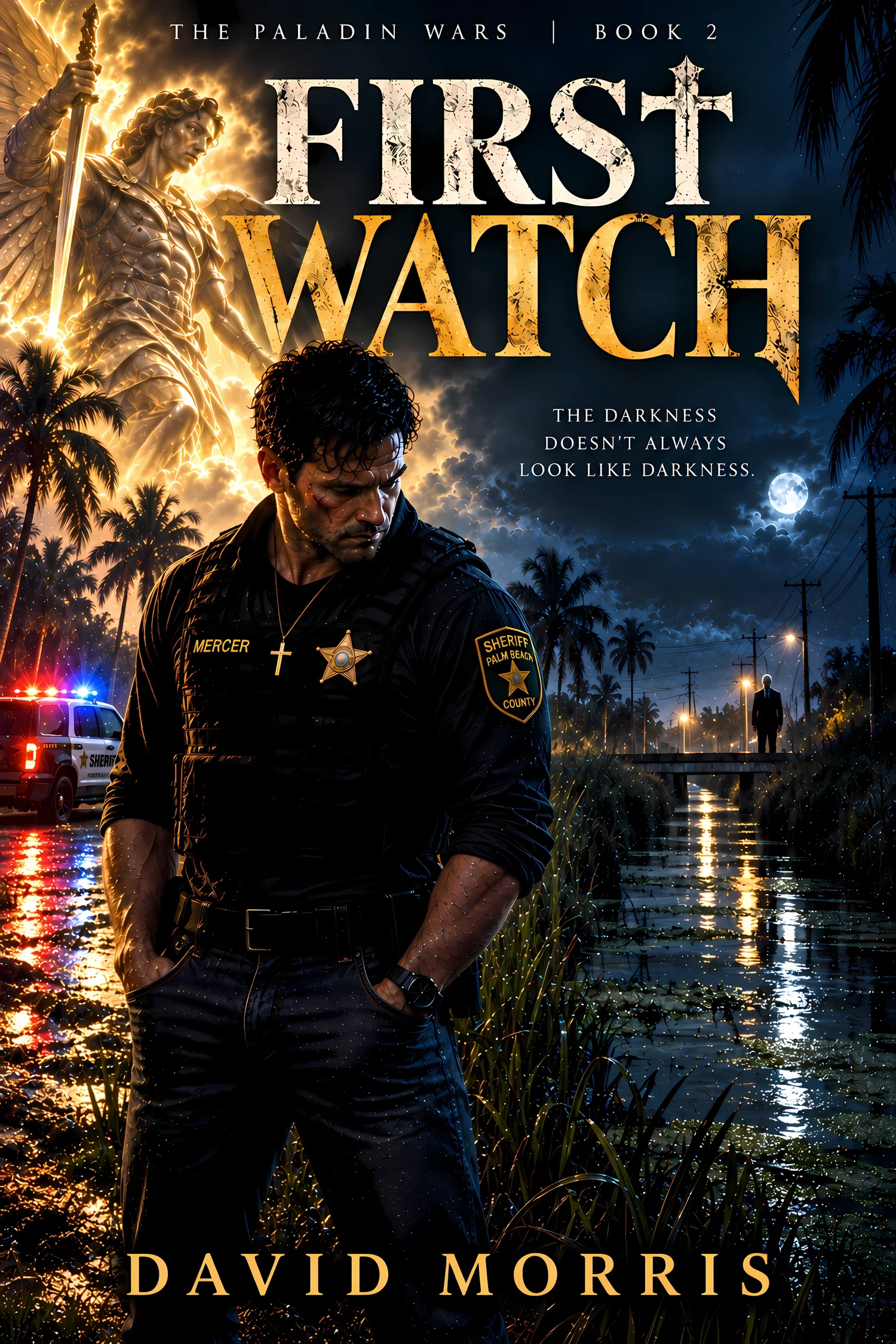
First Watch
Christian Urban Fantasy / Supernatural Police Thriller
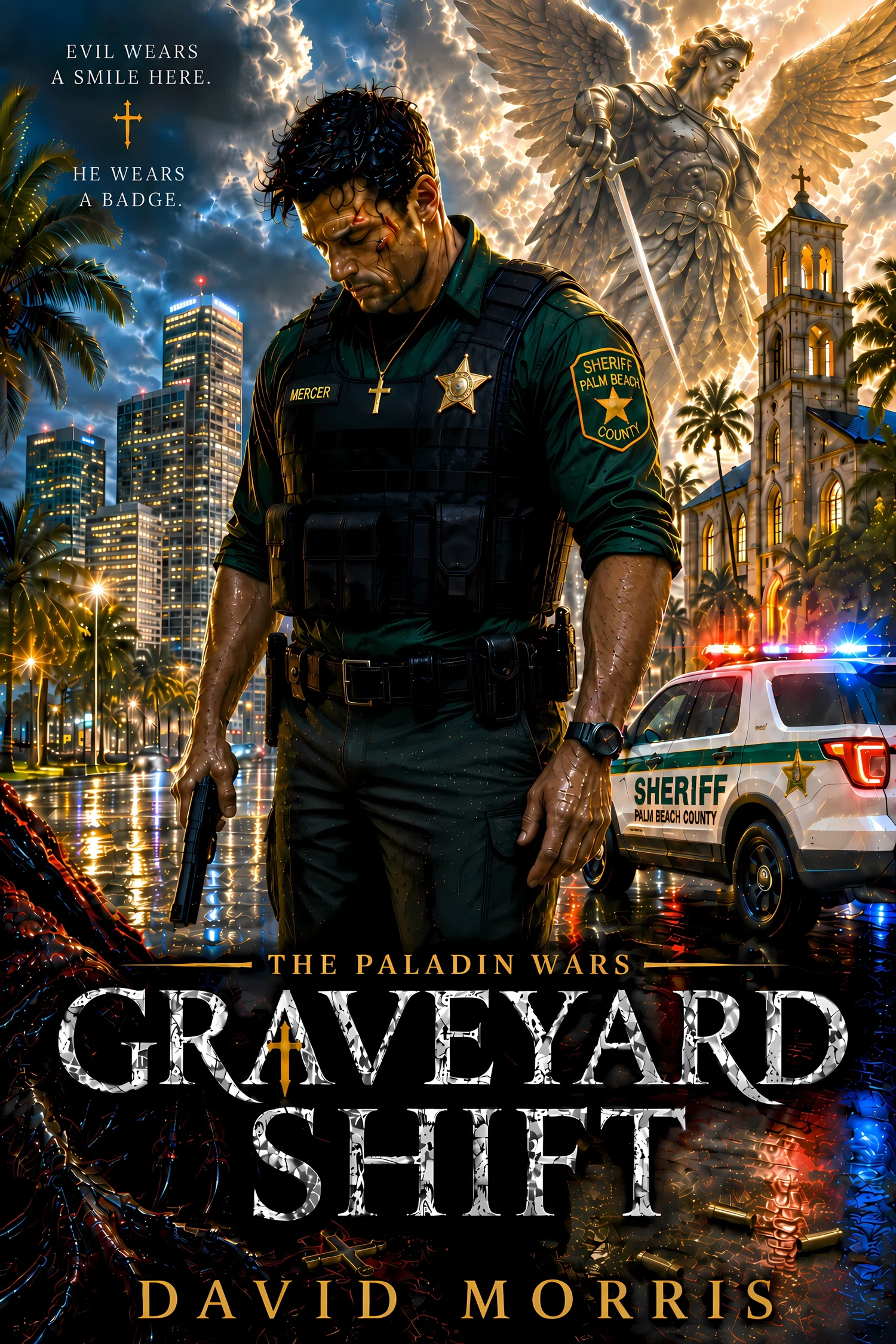
Christian Urban Fantasy / Supernatural Police Thriller
Every cop remembers the call that nearly killed them.
by David Morris
reader promise
Every cop remembers the call that nearly killed them.
cover copy
Every cop remembers the call that nearly killed them.
Daniel Mercer remembers the one that did.
A woman was screaming. A child was trapped. Daniel went through the door because that was the job—and died saving the family inside.
Death should have ended his watch.
Instead, Daniel awakens on a battlefield older than mankind, where Michael, Prince of Heaven’s Host, commissions him as a Paladin: a warrior granted the authority to confront the evil hiding behind human faces.
Then Daniel is sent back.
He returns to Palm Beach County wearing the same badge, carrying the memory of his own death, and working beside the partner who watched him die. He still answers calls and investigates murders.
But now he can see what no one else can.
When a grieving widow asks Daniel to investigate her husband’s impossible death at a luxury hotel, he uncovers reports of faceless guests, a hidden chamber, and something ancient beneath the building that already knows his name.
The deeper Daniel digs, the harder it becomes to separate police work from spiritual warfare. His new power does not answer only to what he does, but why he does it—and Daniel’s hunger for justice is beginning to look dangerously like wrath.
To protect his family and stop a century-old evil, Daniel must trust the partner he has been lying to, accept the allies he never wanted, and learn that faith was never meant to be carried alone.
Hell believed the age of Paladins was over.
IT WAS WRONG.
Graveyard Shift is a gritty Christian urban fantasy thriller blending supernatural crime, spiritual warfare, police procedural suspense, dark humor, found family, and a reluctant paladin’s battle to protect his family, his county, and the names the darkness tried to erase.
Perfect for readers who enjoy angels and demons, morally complex heroes, faith-driven supernatural suspense, high-stakes investigations, and contemporary fantasy where every miracle comes with a cost.
sample chapters
Formatted for comfortable reading on desktop and mobile.
“I’m telling you,” Terrell Boyd said from the passenger seat, “that’s not a taco.”
I glanced at the foil lump in his hand. “It came from a truck with a taco painted on it.”
“That truck is false advertising.”
“Sue ‘em.”
“Just might.”
Rain had come through an hour earlier, slapping the palm fronds flat before steam lifted from the asphalt in pale sheets. Belvedere Road still ran wet in the outside lanes. Water filled the swales behind the fences and plaza signs. Every light along the road broke there and shook when a car went past.
“You’ve got to file a complaint first. Need some evidence.”
“Got some right here.” He took another bite. Terrell had strong opinions about food and weak follow-through when hungry. Six feet two, shoulders packed into a vest and uniform shirt both cut for a smaller argument, grin too easy for a Riviera Beach kid who learned early which corners taught with gunfire. He could talk a drunk off a balcony, talk a sergeant out of a bad mood, and talk himself into buying gas-station sushi if the shift ran long enough.
The last one was why I kept antacids in the center console.
I drove east with the windows cracked because the cruiser air had quit blowing cold around ten-thirty, and county maintenance had marked the work order as pending. Pending meant December; it was October.
Dispatch rolled through the radio in bursts: noise out of Lake Worth, a vehicle burglary off Military, somebody cutting west on Southern like the turnpike paid prize money.
Before ten, people still believed the day could be salvaged. After midnight, they started confessing with volume. Fists through drywall. Boyfriends in driveways. Ex-wives with keys they swore they gave back. Teenagers trying to outrun consequences in cars their parents still owed money on.
The radio stitched it together in signals, ten-codes and street names, unit numbers and brief little bursts.
Show me en route. Copy, rescue staging. Start me another car.
I’d learned to hear the difference between a report call and a blood call. Reports had edges. Blood leaked through the radio before anyone said weapon.
Terrell balled up the foil and aimed for the trash bag behind my seat. Missed by a foot.
“Your range work is paying off,” I said.
“Wind caught it.”
“Windows are cracked two inches.”
“Man, this cruiser’s got its own weather system. Ain’t nothing I can do about the sky.”
I reached up and adjusted the visor an inch lower. Rachel looked back at me from the inside flap.
The photo was three years old and curled at the corners from heat. Her hair was tied back with a red bandanna. Abby sat on her hip, four years old, face smeared with cupcake frosting, one hand mashed against Rachel’s cheek. Rachel had written on the bottom in blue pen.
My two deputies. I kept the visor down far enough to see the road and not enough to explain myself.
Terrell saw it anyway. He always did. He also knew when not to talk, which was one reason we were still partners and not a cautionary tale in roll call.
The radio cracked.
“Bravo Two-Seventeen, Bravo Two-Twelve. Signal Thirty-Eight: Eleven-forty-three Banyan Court, cross of Belvedere. Anonymous Caller reports male intoxicated, female screaming, juvenile in residence. No weapons seen. Caller disconnected.”
Terrell’s hand left the taco.
I keyed the mic. “Bravo Two-Seventeen, fifty-one.”
“Two-Twelve, fifty-one,” another unit answered, farther out.
Terrell sat up and wiped his fingers on a napkin. The joking went away without ceremony. Good cops changed temperature fast. Terrell changed faster than most.
“Banyan Court,” he said.
“Old single-families. Some rentals.”
He checked his sidearm by touch. “Caller neighbor?”
“Sounded like.” I checked mine too, because sometimes stupid things happen. Like forgetting your gun in the sally-port safe before you left after dropping off a drunk and cleaning piss off the plastic seats.
“No weapons seen.”
“Means one weapon missed.”
“Or two.”
I turned west, and the county changed by parcels. New stucco walls rose behind cinder-block houses, and canals cut behind yards where old boats sagged on trailers. The sun had bleached the registration stickers until they looked like ghosts. Rain rinsed grit into the swales and left runoff trembling against the canal banks.
Terrell pulled up the call notes on the mobile terminal.
“Caller was next door,” he said. “Female voice. Wouldn’t give a name. Said the male half came home around eleven, yelling about money. Heard glass break. Heard a kid crying. Line dropped.”
“History?”
He tapped keys with one finger. “Two prior disturbances at the address. One report six months back. No arrest. Female refused statement.”
“Male?”
“Call history says Carla Jimenez. No male listed.”
“Of course.”
“Could be boyfriend.”
“Could be brother.”
“Could be nobody’s business until he starts throwing glass.”
“Sounds about right.”
Terrell read another line and his face lost the last trace of taco.
“Juvenile listed on prior call history. Age six.”
Abby was eight. Close enough for the mind to do bad math. I kept both hands on the wheel.
“No room for screw-ups,” I said.
“Always.”
“Tonight we do it cleaner.”
He looked at me for half a second, then back to the screen. “Copy that.”
Banyan Court sat two turns south of Belvedere, a six-house dead end with neither banyans nor a court and a sodium streetlamp at the mouth, its light half burned out.
Dispatch came back. “Bravo Two-Seventeen, caller advises loud crash from inside. Female still screaming. Juvenile crying.”
I killed the headlights before the turn. Terrell looked at me.
“Don’t like this setup,” I said.
“That makes two of us.”
“The street is empty. Porches dark. Even the dogs are quiet.”
Most domestic calls had a shape before you got there. Porch lights. Neighbors peeking through blinds. A dog losing its mind. A man yelling because he wanted witnesses or because he had lost the ability to care who heard.
Banyan Court had none of that.
TVs flashed blue behind curtains. A wind chime ticked once, then quit. A porch bulb burned yellow over a white door with three old kick dents below the knob. A tricycle lay on its side in the yard, one pink wheel still spinning from the rain runoff.
Only a child crying inside, thin as wire through the front wall.
The third house on the left looked too neat for the noise coming through its walls. Hurricane panels leaned beside the carport though no storm had earned them, and the trash cans at the curb faced the street with their handles lined up like somebody had measured them.
This yard looked arranged. I hated arranged. Terrell heard it too. He came off the window by an inch.
I parked two houses down, nose out. “Advise Two-Twelve we’re on scene. Stage rescue until we call them in.”
He keyed up, voice clipped. “Bravo Two-Seventeen on scene. Audible juvenile distress. Send rescue to stage at Belvedere and Haverhill. Expedite Two-Twelve.”
Dispatch acknowledged as I stepped into heat that pressed wet cloth against my neck. My vest had rubbed a raw patch below my collarbone since sundown. It picked that moment to remind me.
Good. Pain kept the brain honest.
Terrell came around the front of the cruiser, and we crossed the curb into wet grass without talking. He took the windows. I took the door. Right hand free, left hand low, porch boards damp under my boots.
The neighbor’s porch across the street had a camera over the mailbox. Red light on. Good. If we lived long enough to care about evidence, somebody had given us a gift.
I didn’t look at the tricycle again.
Looking at kid things on domestic calls never helped. You logged them after. You let them matter after. During, you made your hands do the job.
Inside, the child stopped crying, and the silence tightened every muscle in my back. I put one knuckle to the door.
“Sheriff’s Office,” I called. “Open the door.”
A woman sobbed once. Cut off hard.
Then a man’s voice came through the wood.
“We’re fine.”
Two words. Flat. Too flat for drunk. Too clean for rage. Terrell looked over from the window and gave me two quick signs. Female right. Kid unknown.
I nodded.
“Need you to open the door,” I said. “We got a call. We have to lay eyes on everybody.”
“Go away.”
“Can’t do that.”
“She called you?”
The temperature dropped at the door, a thin cold line across my knuckles, like the house had a freezer breathing through the jamb.
I pulled my hand back. Terrell saw that too.
“Daniel,” the man behind the door said.
Low. Warning, not question. I leaned toward the crack between door and frame.
“Who am I speaking with?” I asked.
The man laughed.
It came out delayed, as if another mouth deeper in the house had started first and his had followed.
“You know my name.” I hadn’t told him mine.
Terrell had moved off the window and set at the hinge side, handgun still holstered, body angled for the kick if we needed it. His radio spat static against his shoulder. Two-Twelve was still three minutes out. Three minutes is an hour when a child goes quiet.
“Sir,” I said, “step away from the woman and come to the door.”
Furniture scraped inside.
A small voice said, “Mommy?”
Then the woman screamed.
I hit the door once with my boot below the lock. Old frame. Bad screws. The jamb split, but the chain caught and held.
Terrell slammed in beside me. The chain ripped out on the second kick and the door flew inward, cracked the wall, bounced halfway back.
The door opened on the blue stutter of a muted cooking show. A beer bottle rolled beneath the coffee table, and bleach had dried in pale streaks across the tile. A lamp lay on its side near the couch. Carla Jimenez was on the floor with blood in her hair and one arm hooked around a little boy in dinosaur pajamas.
The man stood in the kitchen entrance in a white tank top and bare feet, sweat shining on his chest.
His right hand stayed behind his thigh. Gun.
“Drop it!” Terrell shouted.
I moved left, taking the mother’s line first, because bodies before evidence. Always. I got between the kitchen and the couch, muzzle up, front sight on his sternum.
“Let them move,” I said.
The man’s eyes found me.
I’d seen rage, meth, panic, drunk shame, and the blank look after a man had done the thing he couldn’t pull back.
This was none of those.
His pupils sat wide in brown irises, but the eyes behind them felt farther away than the room allowed. Like looking down a hallway where no hallway should fit.
“You came,” he said.
The woman dragged the boy toward the far wall, too slow, legs refusing to work right. The boy stared at me over her shoulder, cheeks wet, one hand clamped around a plastic stegosaurus.
“Ma’am, keep moving,” I said. “Terrell.”
“I got them.”
Terrell slid toward the couch, weapon on the man, body ready to scoop both if the gun came up.
The man smiled.
I didn’t like that either. Real smiles pulled skin around the eyes. This one only used the mouth.
“You don’t know where you are,” he said.
“Kitchen of a bad rental,” I said. “I’ve been to worse.”
Terrell gave me half a look. There he is. The man brought the gun out.
Everything narrowed to the shot. His wrist settled behind my front sight. Terrell held an angle past the fallen lamp while Carla dragged Luis by inches. The boy’s fist had locked around the dinosaur. Behind the gunman, a curtain had been taped across the back door glass and the deadbolt sat too high for a child to reach.
“Drop the gun,” I said.
He aimed at the child. I fired.
My first round hit his shoulder and turned him enough that his shot went high and blew plaster off the wall over the couch. The boy screamed. Terrell grabbed him and his mother, hauled them behind the couch with one arm, and fired twice past the lamp.
The man staggered into the kitchen. I went after him. Ugly on paper. Necessary with a child behind me and a gun still in play.
Yellow tile ran out after eight feet. Cheap cabinets boxed him toward the refrigerator on his left and the sink on his right, and every step he took crushed cereal under one bare heel. He backed past a birthday invitation pinned to the fridge by a cartoon rocket.
Luis, age six. Later that detail would try to come back.
In the moment, it was another civilian marker. Another reason to keep the gun pointed at me.
He raised the gun again. I hit him center mass. He didn’t fall.
The round punched fabric, blood opened, and his body rocked back like meat on a hook. His face stayed pointed at me.
Then he said my name.
“Mercer.”
I hadn’t given it. The room went cold enough to hurt my teeth. He fired.
The first round caught my vest and drove the air out of me. I hit the doorframe, stayed upright because training is mostly refusing to let your knees fold.
The second went under the vest. Left side. Hot nail through meat.
I fired again. Missed high. Cabinet door snapped behind him.
Terrell shouted from the living room. I couldn’t make out the words. The radio screamed. The boy kept crying.
The man stepped toward me, gun loose in his hand now, blood soaking his shirt. He should have been down. He should have been on the tile begging, cursing, trying to breathe.
Instead he watched me with those far-off eyes.
“Too late,” he said.
The third shot hit me below the ribs. My legs quit.
I went down in the kitchen doorway, half in tile, half in carpet, with my left hand pressed against a hole that pumped warm through my fingers. Terrell fired from somewhere behind me. Three fast rounds. The man’s head snapped back against the refrigerator, and this time the body remembered what bodies do.
It dropped. Terrell was over me before the echo left the room.
“Stay with me,” he said.
“Kid?”
“Out. Both out. Stay with me.”
Good. That was the whole report, if I ever got to write it.
I tried to breathe and got wet copper instead. Above me, the kitchen light ticked in its plastic cage beside a brown water stain that looked like Florida sliding into the Gulf. Terrell tore at my vest straps, then shoved both hands into my side.
“No,” he said. “No, no, no. Daniel, look at me.”
I looked past him.
The visor photo came up behind my eyes. Rachel and Abby, bent from the heat, blue ink at the bottom in Rachel’s hand.
My two deputies. Terrell pressed harder.
“Rescue is coming,” he said. “You hear me? They’re coming.”
I heard sirens. Far off. Too far.
The woman was outside now. I could hear her coughing in the yard, hear the boy sobbing into her shirt. Alive sounds. Messy and scared and furious.
Good sounds.
“Terrell,” I said.
“Don’t talk.”
“Report.”
“Shut up.”
“Child clear. Mother clear.”
“I said shut up.”
I wanted to tell him the house was still cold. Wanted to ask why the dead man had known my name. Wanted to ask why the dark gap above the kitchen light looked less like a stain now and more like a door cracked open.
None of that belonged in a report.
Terrell’s face bent over mine. Sweat ran down his temple. His hands were red past the wrists.
“Stay,” he said.
I tried.
For Abby. For the photo. For Terrell, who had never learned how to lose people without taking it personal.
The kitchen light went white.
Then the light changed.
I died angry.
That’s not the part they put on plaques. Plaques like courage and sacrifice and line of duty. They skip the tile against your cheek and the copper in your mouth. They skip your partner trying to hold your blood inside you. What nobody carves in bronze is the raw, stupid fury of a body quitting before the will inside it signs off.
I had reports to write.
I had a daughter asleep in a room with unicorn sheets and a night-light shaped like a moon.
I hadn’t packed her lunch. The kitchen light went white.
Then the kitchen was gone.
No tunnel. No harp music. No dead relatives waiting in clean clothes. I didn’t float above my body and admire the paramedics. I fell forward through white and hit my knees on black dirt.
Real dirt. It punched pain up both legs.
My hands sank into ash. Fine gray powder coated my palms and filled the lines of my skin. The air tasted of iron, rain, and burned stone. Wind dragged grit across my face hard enough to make me turn my head.
I was still in uniform. My vest rode high on my ribs. My duty belt still dragged at my hips. The holster was empty.
Of course. I pushed up and nearly went down again.
The ground rolled away under a sky the color of a bruise before it yellows. What I’d taken for hills shifted and broke into ranks. Soldiers. Too many to count. Armor caught firelight in hard flashes. Banners snapped above them without fabric sound. Far off, flame climbed a ridge and broke against figures my eyes refused to hold.
The sound arrived late. Metal on metal. Stone splitting.
Voices rose in a language that went through my bones before my ears made any use of it.
I had been in bad scenes. I had stood in rooms after men used whatever the room gave them against one another. A bottle became a blade. A chair became a club. Guns and fists finished what the cheap furniture started. I had watched fire rescue carry out the living and stop looking for more.
This was bigger than bad. My brain reached for words it knew and came back with nothing useful. War.
That one fit poorly and still fit best. I got one boot under me.
“Daniel Mercer.”
The voice didn’t boom. Real command didn’t need volume. This one crossed the field and found me without effort. I turned.
A man stood ten yards away on the black dirt.
He was taller than me by a head, broad through the shoulders, straight-backed under armor the color of dawn striking steel. I looked for wings because my brain was still trying to file him under church art and Christmas cards. Found none. No robe either. No gold hair. The armor took the light in battered plates, scarred at the edges where no earthly weapon could have reached. A sword hung at his side, undrawn.
His face belonged to a soldier who had watched nations rise, burn, and become lessons no one read. Young in no human way. Old in no way I could measure.
His eyes were clear, and that frightened me more than the armor.
“Deputy Mercer,” he said.
I looked behind him at the war.
“Am I dead?”
“Yes.”
The answer landed harder than the bullets had.
I looked down at my vest, expecting blood. No holes. No tear below the ribs. No wet spreading under my hand. My body had stayed in the kitchen. This was me without the parts hospitals could bill.
“That is inconvenient,” I said.
His face didn’t change.
“Yes.”
“Who are you?”
“Michael.”
One word. The name crossed the field without echo.
I swallowed. My mouth had no blood in it now, and I missed the blood because it had made more sense.
“Michael who?”
“Prince of the Host.”
Just title, rank, and enough authority to make every question in me stand at attention against its will.
I laughed once. It came out broken.
“That’s above my pay grade.”
“It is above every pay grade.”
Dry. Flat. If angels made jokes, they did it with no visible paperwork.
The line of flame on the ridge burst outward. Shapes moved inside it, too tall and too thin. The ranks below answered. Light cut through dusk in long white arcs, and the ground under my boots shook.
I reached for the gun that wasn’t there. Michael saw it.
“You are not armed.”
“I noticed.”
“You were killed in defense of the innocent.”
Carla Jimenez on the floor. Luis in dinosaur pajamas. Terrell’s hands red past the wrists.
“Are they alive?”
“The woman and child live.”
The ground steadied under me, or I did. Hard to tell.
“Terrell?”
“Alive.”
“Then send me back.”
“That is one option.”
There it was. The hook in the line.
I turned fully toward him. “What is the other?”
“The grave.”
He said it without menace. The grave wasn’t a threat to him. It was a location.
“You are giving me options while my body is on a kitchen floor.”
“Yes.”
“That’s not how death works.”
“You have not died before.”
“I’ve attended.”
“Attendance is not expertise.”
There was no bite in the line. That didn’t help.
“If this is court,” I said, “I want counsel.”
“This is not court.”
“Then what is it?”
“A call.”
He said the word the way dispatch did, stripped down and load-bearing.
My mouth went dry. I could still hear the radio under Terrell’s voice. Could still hear the woman coughing outside. Could still see the boy’s plastic dinosaur locked in one small hand.
“I already answered it.”
“You answered the first part.”
I looked past him again. The war went on. Ranks bent and surged. Fire ran along blades. Far overhead, wings crossed the bruised sky and dropped into smoke. My eyes watered before I could make more out of them, and some inner mercy made me stop trying.
“If this is a choice,” I said, “you’ve picked a strange setting for it.”
“You required context.”
“I required a trauma surgeon.”
“You have several.”
“Then I would like to speak with them.”
“They cannot hear you.”
“Convenient.”
Michael stepped closer. His armor stayed quiet. I hated that.
“This war is real,” he said. “It has been fought since before your county had a name, before your nation had a flag, before men learned to write their victories on stone.”
“I’m a sheriff’s deputy.”
“Yes.”
“I answer domestic calls. I serve warrants. I write reports that nobody reads until court.”
“Yes.”
“This is not my case.”
“It became your case when you entered the house.”
That hit the same place as Luis’s cry.
I looked at the ash on my hands. It had packed under my nails. Death, apparently, still had details.
“The man in the house knew my name.”
“Yes.”
“Why?”
“Because you were seen.”
“By who?”
Michael didn’t answer. The silence had structure. Not ignorance. Orders.
I had given silence like that in interviews, in briefings, and on doorsteps where a mother asked whether her son had suffered and the truth had no legal use.
I hated it more from this side.
“You know who killed me,” I said.
“I know who moved against you.”
“So you do.”
“It is enough for this briefing.”
“Not for me.”
“You are not being offered command.”
The words cut clean. No anger in them, no insult either. Just rank.
I took one step toward him before training caught up. “I was lying on a kitchen floor thirty seconds ago.”
“Less.”
“My partner was trying to keep my blood in.”
“Yes.”
“My daughter is going to wake up and my mother-in-law is going to get a call from someone who uses the phrase we did everything we could.”
Michael’s face changed. Not much. Enough.
“Your daughter sleeps,” he said.
There. The one kindness. It hurt worse than the bullets.
“Don’t do that,” I said.
“Do what?”
“Talk like you know her.”
“I do know her.”
My hands closed on ash. Not a weapon. Still, they closed.
“Where were you when Rachel died?”
The sounds behind him dropped. The ridge fire dimmed at the edge of my vision. Michael didn’t move.
“Present,” he said.
One word, and I wanted to hit him. I wanted it with a force that scared me, not because it felt wrong. Because it felt clean.
“Present,” I said. “That is the answer?”
“It is the answer I may give.”
“She prayed.”
“Yes.”
“I prayed.”
“Yes.”
“She died anyway.”
“Yes.”
He didn’t soften the word. Neither did he. That made it crueler and more honest than comfort.
I looked away first.
Downfield, a banner fell. Three figures closed around it before it touched the dirt. One took a spear through the chest and kept both hands on the pole until another soldier reached him. Then he went down.
No one stopped the war to explain it.
“Why am I here?” I asked.
Michael drew no sword, raised no hand, summoned no music. He spoke like a commander giving an assignment at the edge of a map.
“You have been offered a commission.”
“By who?”
“The throne.”
My throat tightened. I didn’t give it a name.
“Doing what?”
“Return to the world as a Paladin.”
The word struck the dirt between us.
I knew it from movies, games, stained glass, old jokes about knights who smiled too much. None of those survived his voice.
“I’m not a knight.”
“You are a man who entered a house to save a child.”
“That is my job.”
“It is also your answer.”
“To what?”
“To whether you will go where you are sent.”
“A Paladin is not an angel. Not a priest. Not a magician. A Paladin is a living human being invested with authority to make war on the kingdom that moved against you tonight.”
There were ten questions in that sentence. I picked the one with teeth.
“Authority to do what?”
“See what is hidden. Stand where others cannot stand. Speak judgment where judgment has standing. Break chains that were never meant to hold mankind.”
“That sounds like a sermon.”
“It is an operational summary.”
“What does it cost?”
“You.”
No hesitation. No sales pitch.
“That is not specific.”
“It is exact.”
“My daughter pays?”
“No.”
“My partner?”
“No.”
“People near me?”
“They will be endangered by what opposes you; they are already endangered by what opposes mankind.”
“Then the answer is yes.”
“It is a warning.”
“Those sound alike from here.”
“They often do.”
I looked at the field again. Tried to count the nearest rank and failed before ten because scale kept breaking the math. A soldier with half his helmet sheared away dragged another out of a ditch cut into the black dirt. Neither looked toward me. Nobody had time for the dead deputy asking entry-level questions.
“If I go back,” I said, “do I still bleed?”
“Yes.”
“Can I be killed?”
“Yes.”
“Can I quit?”
“You may disobey.”
“That is not what I asked.”
“It is the answer.”
There it was again. Command-language. Narrow as a hallway.
The field shook again, closer this time, hard enough to jump dirt around my boots. Michael looked past me, and the clear calm in his face sharpened into command. Behind him, a line of soldiers changed course at once, orders passing in a language I felt more than heard.
His attention returned to me.
“If you refuse, you go to the grave.”
“Hell?”
“The grave.”
“Sounds like an answer designed by legal.”
“It is an answer designed by mercy.”
I had no reply to that.
“If you accept, you return to your body. You will live. You will carry authority not your own. You will be marked. You will be opposed. You will be known.”
“Known by who?”
“Below.”
The cold from the house came back in memory. Doorjamb against my knuckles. The man’s eyes too far away. My name in his mouth.
Mercer.
“The man in the kitchen.”
“A rider.”
“A what?”
“Not yet.”
I barked a laugh. “You people are very fond of that.”
“Timing matters.”
“So does informed consent.”
“You know enough to choose.”
“Do I?”
“You know a child lived because you went through the door.”
That shut me up. Michael let it.
Luis’s dinosaur. Carla crawling. Terrell hauling them behind the couch. The gun coming up.
I could still feel the kitchen tile under one knee. Memory, not body. The body was elsewhere with paddles on its chest and a man yelling my name.
“And if I refuse?”
“You go where men go when their days are ended.”
“Does refusing make me a coward?”
“No.”
That answer came too fast for comfort.
“Then why offer?”
“Because a yes given freely has standing.”
“Standing where?”
“On earth.”
He stopped there. A door shut behind the word, and I knew I had reached another place marked not yet.
Earth. Kitchen floors. Porch lights. Mothers crawling with blood in their hair. Kids with dinosaurs. Deputies with radios and no category for the thing in the room.
Apparently that counted as my jurisdiction.
“If I say yes,” I asked, “do I get answers?”
“Some.”
“About Rachel?”
“Not the answer you want.”
“You don’t know what I want.”
“I do.”
No cruelty. No softness either.
“Then you know I want her back.”
“Yes.”
“Can you do that?”
“No.”
That was mercy. It landed like a door locking anyway.
I looked out over the field because looking at him cost too much. Soldiers moved through flame. A horn sounded. No melody. Command. The ranks answered, and for one instant the whole ridge lit white.
In that light I saw faces. Human faces.
Men and women in armor from a hundred eras and from none of them, scarred and bloodied and laughing under strain, afraid and moving anyway.
Then dusk took the ridge again.
“Why me?” I asked.
“You said yes before you knew the question.”
“When?”
“At the door.”
The porch. The child going silent. Terrell at the hinge side. My boot under the lock. I almost told him any deputy would have done the same. I’d been to enough scenes to know that wasn’t true.
“I don’t trust you,” I said.
“I know.”
“I’m angry.”
“Yes.”
“I’m not signing up for church recruitment.”
“No one asked you to.”
“And if I take this back, I’m still me.”
“Yes.”
“Widower. Deputy. Father.”
“Yes.”
“Still angry.”
“Yes.”
“That doesn’t disqualify me?”
“No.”
The answer took more from me than I wanted. I looked down at my hands. Ash in every crease. No blood, no gun, no report. Just a choice.
“The kid lived,” I said.
“Yes.”
“Others won’t.”
“Many will not.”
“Unless I go back.”
“Some will live if you go back.”
A plain operating fact.
I thought of Abby asleep under her moon light. Thought of Deb’s phone ringing before dawn. Thought of Terrell with my blood on his hands and no joke big enough to cover it.
Then I thought of Luis in dinosaur pajamas, alive in his mother’s arms because we went through the door.
You didn’t need healed faith for that. You needed a door. You needed someone to go through it.
“All right,” I said.
Michael’s posture changed by less than an inch. Ranks near him shifted in answer.
“Speak plainly.”
Of course. Paperwork at the end of the world.
I faced him. “I accept the commission.”
The ash under my boots flashed white. Pain hit.
Not the bullets. Deeper. Sternum first, like a brand pressed through bone, then out along every rib. I locked my teeth and stayed upright because falling in front of an archangel felt like a bad start to a new job.
Michael stepped close and placed one hand over my chest.
“Daniel Mercer,” he said, “rise under warrant.”
The field vanished.
For half a second there was only fire in my blood and Terrell’s voice tearing itself raw in another world.
“Clear!”
Electricity slammed me into the kitchen floor.
I came back with the taste of ash in my mouth, a burn over my sternum, and my partner shouting my name like he could drag me the rest of the way by force.
I opened my eyes.
Terrell was there.
So was the pain.
So was the light.
It started in my chest, found the cracks in my ribs, then crawled into my side and up a throat scraped raw by a tube I didn’t remember accepting. Tape pulled at the skin around the IV in my left arm. My mouth was dry enough to make my tongue feel borrowed.
The monitor marked time beside the bed.
I opened my eyes when fluorescent glare cut through my lashes. Ceiling tile floated above me, white and close, with a sprinkler head punched through it and a red glass bulb fixed in its cage.
St. Mary’s, if the blue logo on the curtain meant what I thought it meant.
That tracked. Gunshot trauma in Palm Beach County bought you lights, sirens, and a hard ride to the Level One center on Forty-fifth Street if rescue could keep blood inside you long enough to move.
I tried to sit up. The bed rails stopped me. So did the wound in my left side.
I made a sound I would deny under oath.
“Don’t do that,” a nurse said.
She appeared on my right and put a plastic cup where I could see it before I could bargain for anything stronger. Her badge said IMELDA R. Purple gloves snapped at her wrists. Tape covered her wedding ring. Her eyes said bigger men than me had already tried her before breakfast and lost.
“I need to know where my partner is,” I said.
My voice came out scraped thin.
“Waiting area. He’s been arguing with a vending machine since I came on.”
“Sounds stable.”
“I don’t referee. Drink that first.”
I blinked once. The room stayed where it was. A curtain ring clicked in the air conditioning, and the monitor kept marking time while red fed from a clear bag, through a pump, and into my arm.
Not my favorite color at the moment.
“My daughter?”
“Family is here,” Imelda said. “Your mother-in-law has the waiting room on a schedule. She fed one of my residents. Nobody stopped her.”
“Deb.”
“Deb.”
Good. If Deb Kowalski had command of the waiting room, no hostile force below battalion strength was getting near Abby.
“How long?” I asked.
“Two days since surgery.”
Two days. I closed my eyes.
The kitchen came back in pieces. Luis in dinosaur pajamas. Carla Jimenez crawling. Terrell’s hands red past the wrists. The man in the kitchen saying my name.
Then Michael.
Then my own voice saying yes. I opened my eyes again.
“Did I die?”
Imelda didn’t answer fast enough.
Nurses were good at fast answers. Pain scale. Medication time. Doctor will be in. Family can come back for ten minutes. That pause told me more than the chart would have.
“You need to ask the surgeon,” she said.
“I’m asking the person who checks the machines.”
“Your heart stopped in the trauma bay. They got you back.”
“How long?”
“Long enough that the floor is saying miracle. I chart minutes, not miracles.”
The word gave people permission to stop asking exact questions.
“Where is Terrell?”
“I’ll get him after you promise me the feet stay in the bed.”
“I promise not to succeed.”
Imelda looked at the rail, then at me.
“Deputy Mercer.”
“Daniel.”
“Daniel. You have two gunshot wounds, surgical drains, cracked ribs from compressions, and a chest that looks like we used you to train new paramedics. If you climb out of bed, I will call your mother-in-law.”
“That’s excessive force.”
“It’s on your whiteboard.”
She tapped the board by the door on her way out. Under my medication times, in block letters: DO NOT CLIMB.
A doctor came in before Terrell. He was young, with his surgical cap still in his pocket and eyes too awake for the hour, which meant he’d either slept or crossed the point where sleep turned theoretical.
“Deputy Mercer,” he said. “I’m Dr. Ibarra.”
“You the one who climbed on my ribs?”
“One of four. Mine was the two a.m. shift.”
“I want names for the complaint.”
“When you can lift your arm to sign it, I’ll bring the form myself.”
Fair.
He checked the dressing, listened to my chest, flashed a penlight across my eyes, and asked me who the president was, where I was, and what year the county thought it was. I answered all three. He looked less comforted than I wanted.
“You lost a great deal of blood,” he said. “You had abdominal surgery, chest trauma, and a cardiac arrest in the bay.”
“But other than that.”
“Other than that, your presentation is outside anything I can cite. I’ve stopped saying so in front of the residents.”
“That sounds inconvenient.”
“It is. My goal for you is forty-eight hours of clinical boredom. Help me reach it.”
“I’ve never been accused.”
He wrote on the chart and looked at the bandage over my sternum.
“This burn,” he said. “Do you know where it came from?”
The room narrowed to that square of gauze. Michael’s hand. Fire without heat. The commission sinking into bone.
“Defibrillator?” I asked.
“No.”
I waited. He didn’t help me.
“Then no,” I said.
Dr. Ibarra taped the dressing back down with care that made the answer worse.
“If it changes color, spreads, or starts draining, call the nurse.”
“That sentence ever make patients feel better?”
“No.”
“Appreciate the honesty.”
He left me with the machines, the blood bag, and a brand nobody had put in the chart. The door eased open three minutes later.
Terrell Boyd came in with yesterday’s shave, a clean uniform, and eyes that hadn’t slept since Banyan Court. A bandage crossed his left knuckles. In his right hand, a cafeteria coffee cup sagged under his thumb.
He stopped at the foot of the bed. For once, he had no line ready.
“You look terrible,” I said.
He stared at me.
“Too soon?”
The cup bent in his hand. Coffee hit the floor.
Then he was at the bed rail, one hand on the plastic, jaw locked so hard a molar was going to file a complaint.
“You died,” he said.
“I heard.”
“No. You didn’t hear. You were blue on that kitchen floor. You were blue in rescue. You were gone in the bay. I watched a doctor climb on top of you like he was mad at your ribs.”
“Did he win?”
“Don’t do that.”
That cut cleaner than yelling. I shut my mouth.
Terrell wiped coffee off his fingers with a napkin and missed most of it. His hand shook once. He shoved it into his pocket.
“The kid lived,” he said.
That mattered first.
“Luis?”
“Luis Jimenez. Six. Broken wrist from when his mother pulled him down behind the couch. Carla has eight stitches, concussion, bruised ribs. Both alive.”
I let the air out through my nose. It hurt. Worth it.
“Suspect?”
“Dead at scene.”
“Name?”
“Tomas Jimenez. Ex-husband. No current address worth a damn. Had a .38 with two numbers filed off and a protection order he treated like junk mail.”
“He knew my name.”
Terrell looked toward the door.
“You remember that?”
“I remember enough.”
“You remember him eating rounds?”
“Yes.”
“Good. I was starting to wonder if I had cooked that part inside my own head.”
The room tightened around the bed rail and Terrell’s hands.
“How much did you tell them?” I asked.
“I told them he didn’t drop when he should’ve. I told them he named you. I told them the house was cold.”
“And?”
“And IA wrote it down with faces they use when deputies have been awake too long.”
“Fair.”
“No, not fair. Accurate but not fair.”
He pulled the visitor chair closer with his foot and sat hard.
“Sheriff’s downstairs,” he said.
“Why?”
“Press.”
“For me?”
“No, for the vending machine. Yes, for you.”
“Already?”
“They held off until the hospital said you were awake.”
“Charitable.”
“Command wants a clean line before the afternoon cycle. Deputy shot saving child. Suspect dead. Partner heroic. Trauma team heroic. Community grateful. Investigation ongoing.”
“No room for dead deputy talks to archangel.”
“You want me to add that?”
“Leave it out of the first draft.”
“Strong media strategy.”
I turned my head toward the muted television in the corner. Imelda must’ve killed the sound. Closed captions crawled under a shot of the St. Mary’s lobby, where Sheriff Warren Pruitt stood at a podium with the PBSO seal while camera lights turned his dress uniform sharp enough for campaign mail.
HERO DEPUTY SURVIVES LINE-OF-DUTY SHOOTING.
“Hero deputy,” I said.
“You prefer ‘guy who bled on my boots’?”
“More accurate.”
“Harder to fit in a lower third.”
The sheriff spoke without sound. Captions crawled beneath him: courage, family, prayers, medical excellence, community support. The usual words, arranged to survive the afternoon news.
Prayers. That one hit a rib the surgeons hadn’t touched.
“Abby saw this?”
“Deb kept her away from the TV.”
“But she knows.”
“She knows you got hurt; she knows doctors helped. She knows she can see you when the nurse says yes.”
“Does she know I died?”
Terrell’s face closed.
“No.”
“Keep it that way.”
“That’s not my call.”
“Terrell.”
“Daniel, your kid is eight. She knows adults lie when they use too many soft words.”
I looked at the blood tube. Red through clear plastic, moving in pulses too neat to be natural. My chest burned under the dressing. Not surgical pain. Deeper. Centerline. As if a hot coin had been pressed into bone.
“I saw Rachel,” I said.
Terrell went still. I hadn’t meant to say it. He leaned in by half an inch.
“What?”
No. Wrong door. Michael’s field. Rachel’s name. The answer I didn’t get. The yes I gave anyway.
“Drugs,” I said. “Anesthesia. Head injury. Pick one.”
Terrell stayed with me long enough to make the lie count.
“You want to try that again?”
“Not today.”
He sat back.
“Yeah. I figured.”
The door opened before I could make it worse. Deb came in first, short and square and iron-gray, carrying a tote bag big enough to supply a shelter. Abby followed in a yellow hoodie with a faded cartoon knight on the front. Her hair had been brushed into two uneven braids. Deb’s work. Rachel used to get them even. I used to say uneven had character.
Abby stopped two steps inside. I had faced guns with less fear than I felt in that pause.
Tubes make a man smaller. Tape does too. Hospitals turn fathers into assignments for people in soft shoes.
“Hey, bug,” I said.
Her mouth folded. She ran to the bed, then stopped at the rail because Deb caught her hood.
“Careful.”
“I know,” Abby said, and climbed onto the chair instead.
She reached through the rail and put two fingers on my wrist, away from the tape.
“Does it hurt?”
“Only when I fight nurses.”
Her eyes went huge.
“Did you?”
“Not well.”
Deb made a sound that might have been a laugh if it had slept.
Abby looked at Terrell. “Did he fight nurses?”
“He mouthed off,” Terrell said.
“So yes.”
“Basically.”
She looked back at me with Rachel’s eyes and my talent for accusation.
“Grandma said God helped you.”
There it was. I looked at Deb. She didn’t apologize. She didn’t blink.
“A lot of people helped me,” I said.
“God too?”
My chest burned again. Michael’s voice moved through memory without sound. Free hands. Free yes.
“Yes,” I said.
Abby nodded like she had been waiting for me to catch up.
“I prayed.”
“I know.”
“No you don’t.”
The answer left me nowhere useful to push.
She rubbed my wrist with two fingers. Tiny circles. The kind Rachel used to make on Abby’s back when nightmares came.
“I prayed anyway,” she said.
I looked at the ceiling because the room had too many faces in it. Deb put the tote bag on the counter.
“Doctor says ten minutes,” she said. “Then he sleeps.”
“Doctor says a lot,” I said.
“Doctor has my full support.”
“Et tu, Debbie?”
“You’re alive. Don’t get fancy.”
The TV captions kept crawling. The sheriff thanked St. Mary’s, rescue, the community, then asked for privacy and promised a full investigation. The feed cut to file footage outside the hospital, then to a PBSO website photo of me in uniform, wearing the half-smile command staff required when they wanted teeth.
I looked like a man with no idea what was coming. That made two of us. A woman stood in the hallway beyond the half-open door. She was the only one in the hallway not looking at the television.
She braced a purse against her ribs with both hands, pressing the hospital visitor sticker on her navy blouse into a wrinkled oval. Tight curls had started escaping their pins. Old eyeliner had settled under her eyes. She watched the room number, not me.
Behind her stood a tall man in a gray suit. No badge, no visitor sticker, no reflection in the glass panel beside the door. My fingers went cold.
The man was too thin through the shoulders, too long through the neck, and dry as paper left in a church attic. He leaned near the woman without touching her. Courtesy. He turned his head and looked at me. The brand under my dressing burned so hard I tasted metal.
The gray man stepped back. One pace.
Then another.
He gave me a small nod, like a clerk acknowledging a counter he hadn’t expected to be staffed. Then he walked through the closed supply-room door across the hall. I heard myself breathing through my teeth.
“Dad?” Abby asked.
“I’m okay.”
Lie. Terrell was already half out of his chair, eyes on the doorway.
“What?”
The woman at the hall flinched, then looked into the room as if she had been caught stealing. Her eyes went to the TV, then to my face, then to the badge clipped on Terrell’s belt.
“I’m sorry,” she said. “I didn’t mean to interrupt.”
Her voice had sand in it. Deb moved first. She always moved first.
“Are you looking for family?”
“No. I...” The woman swallowed. “They said Deputy Mercer was awake. I shouldn’t have come.”
“Who are you?” Terrell asked. The big man could be gentle when he needed to.
“Grace Okafor.”
The name didn’t register. Her face did. People who had lived in hospital chairs and grief carried the same posture. Their bags were heavy. Their shoulders sunk, like they were just trying to become the world’s smallest folding chair.
“Do I know you?” I asked.
“No.”
She took one step into the room and stopped when she saw Abby. Instincts or shame, hard to tell when you’re being pumped through with the best medicine county budgets could buy.
“My husband died two months ago,” she said. “At the Alcazar.”
I had driven past the hotel a hundred times. Mediterranean arches held up a red tile roof over money old enough to buy silence and call it historical preservation. Valets worked the front while service corridors took the back, and we got the spillover around the edges. Drunks. Thefts. Trespassers. A jumper once from the parking deck next door.
“I’m sorry,” I said.
Grace nodded like she had heard those words enough to sand them flat.
“He was the night page. The paper said he fell. The hotel said he had been troubled.”
Terrell’s eyes moved to me.
“Mrs. Okafor,” he said, “this isn’t a good time.”
“I know. I saw the news. They said you died and came back.” Her hands tightened around the purse until her knuckles went pale at the edges. “My husband called me before he died. He said the rooms were full of people who had no faces. Then he said a man in the basement knew my name.”
The monitor beside my bed picked up speed. Imelda appeared at the door as if summoned by bad timing and electronics.
“Everyone out for a minute,” she said.
“I’m fine,” I said.
“No. Your monitor says otherwise. Out.”
Deb took Abby’s shoulder.
“Come on, baby.”
“But Dad—”
“Your dad’s going to obey the nurse.”
Abby looked at me. I nodded.
She left with Deb but looked back once. The bed and tubes had already made my daughter practice leaving rooms before she should have to.
Terrell stayed. Imelda gave him one look.
“I’m family,” he said.
“Then stand there, keep your hands off my machines, and don’t talk.”
He stood there. Grace backed toward the hall.
“I’m sorry,” she said again. “I shouldn’t have—”
“Wait,” I said.
The word cost me. She stopped.
“What was your husband’s name?”
“Eli.”
The name sounded ordinary enough to hurt.
“Eli Okafor?”
“Yes.”
“Did he work the night desk?”
“Eleven to seven.”
“Did he leave you anything?”
Terrell’s head turned. There he is. Grace looked at her purse.
The brand burned. Down in the blood tube, near the pump, a thread of silver slid through the red. A living line, thin as wire, bright without casting light.
Imelda followed my eyes.
“What are you looking at?”
I didn’t answer. The silver line bent inside the tube, ran toward my arm, and vanished under the tape. Grace saw it too.
Her purse slipped from her hands and hit the floor.
Inside, beneath tissues and a checkbook and a ring of keys, lay a hotel key card from the Alcazar.
Room 914. Blackened at one corner. Grace stared at the tube before lifting her eyes to me.
“He said I would know who to give it to,” she said.
The monitor beside me kept counting.
Hospitals let you leave in a wheelchair so nobody has to admit escape is part of the treatment plan.
St. Mary’s discharged me at three-thirty on a Friday. Deb carried the paperwork and pill bottles. The plastic basin rode under her arm like the hospital’s final insult. An orderly pushed me toward the doors while reciting everything I could no longer do. Driving. Lifting. Stairs unless the house caught fire. Work until somebody cleared me, and patrol until a surgeon, a captain, and Risk Management all decided I could be trusted with my own body again.
That last one was implied.
Deb parked the SUV as close to the front walk as physics and county code allowed. Terrell stood in my driveway with a grocery bag in each hand and a face like he was ready to tackle me if I looked at the mailbox wrong.
“You know I can walk,” I said.
“Great,” he said. “Walk slow.”
“That’s not walking. That’s losing with style.”
“Then lose pretty.”
Abby waited on the porch in yellow shorts and a Marlins shirt Rachel had bought too big two seasons ago. It fit now. That felt rude. Kids weren’t supposed to grow while you were busy getting shot.
She held a handmade sign against her chest.
WELCOME HOME DAD
The letters climbed uphill across the poster board. In the corner, a blue crayon knight carried a sword in one hand and a shield in the other. Abby had given him a badge too. Smiley face for the seal.
I made it from the driveway to the bottom step before my left side tried to resign. Deb saw my face.
“Chair,” she said.
“I’m good.”
“Daniel.”
“I’m mildly less good.”
Terrell set the bags down and had a hand under my elbow before I could complain. Abby didn’t run. That was worse. She walked down the steps with both hands out, careful as a bomb tech, and touched my wrist where the tape marks had faded yellow.
“Hi,” she said.
“Hi, bug.”
“You look better than the hospital.”
“Low bar.”
“Grandma said I can’t jump on you.”
“Grandma’s been reading medical journals again.”
“Can I hug you little?”
There were easier questions in felony court.
“Yeah,” I said. “Little works.”
She wrapped both arms around my right side and pressed her cheek to my shirt, nowhere near the dressings. I put my good arm around her shoulders. Sunscreen clung to her hair. Crayon wax marked one finger. Under both, the strawberry shampoo Rachel used to buy in bulk because Abby once decided changing shampoo would make her hair forget her mother.
I held on too long. Abby didn’t call me on it. Deb did.
“Inside before you fall over and make me explain you to a paramedic twice in one week.”
“Love you too.”
“I made soup.”
“That’s not the same thing.”
“It is in my house.”
“This is my house.”
Deb let her eyes travel from the porch to Abby’s sign, then to the teal planter Rachel had painted before it learned how to overflow. Her gaze stopped on the front window, where Abby’s paper snowflakes still hung in October because nobody in the Mercer house had the courage to take them down.
“Not this week,” she said.
Hard to argue with command presence. The kitchen tried to be itself and gave up halfway.
Purple circles still marked Abby’s swim lessons on the calendar. Rachel’s recipe cards still hung from twine under the cabinets because she said cookbooks were where good food went to become homework. Deb had shoved the coffee maker aside for pill bottles, planted a discharge folder by the napkin holder, and draped a towel over my chair so the wood wouldn’t catch my bandages.
Injury had revised the house around me. Terrell carried groceries to the counter and started unloading with great seriousness.
“Why do I have five cans of pears?” Deb asked.
“They were on sale.”
“Daniel doesn’t eat canned pears.”
“Man got resurrected. His palate might’ve changed.”
Abby looked up from taping the sign to the pantry door.
“What’s resurrected?”
The kitchen stopped for half a second. Terrell’s eyes went to me. Deb’s hand stayed on the soup pot.
I pulled out the chair and sat before my knees embarrassed me in front of witnesses.
“It means brought back,” I said.
“Like Lazarus?”
Of course she knew Lazarus.
Deb went back to stirring. Terrell stared into the grocery bag like it held a legal defense.
“Close enough,” I said.
“Did you smell bad?”
Terrell coughed into his fist. I looked at Abby.
“Hospital bad or Bible bad?”
“Bible bad.”
“No.”
“Good.”
She pressed the last strip of tape flat and stepped back to judge the sign. “I didn’t want to say it if you did.”
“Appreciate the restraint.”
Deb ladled soup into a bowl and set it in front of me. Rice and chicken slid under the broth. Carrots Rachel would’ve said were cut too small bumped the spoon, and black pepper gathered at the rim. Card number twelve. I didn’t have to look at the twine to know. Rachel had written add lemon if Daniel says it tastes fine because fine means boring.
Deb put a wedge of lemon beside the bowl. I looked at it. She looked at me.
Neither of us said Rachel’s name.
Some rooms have trip wires. Kitchens have them too. Reach for the wrong mug and your hand remembers who bought it. Pull the green-handled knife from the block and Rachel’s voice comes back complaining that nobody else treated it right. Brush the recipe cards and three years come up under your nails.
I squeezed lemon into the soup. Deb turned away too fast. Terrell saved us by dropping a box of crackers.
“I meant to do that,” he said.
“No, you didn’t,” Abby said.
“That’s fair. I ain’t even mad about it.”
My phone buzzed on the table. Deb picked it up before I could.
“No.”
“That’s my phone.”
“It’s also your blood pressure.”
“Those are separate devices.”
“Not today.”
She read the screen and handed it over only after giving me the look that had once made an oncologist apologize for being late.
PBSO Risk Management. Modified duty packet attached. Mandatory admin interview Monday pending medical clearance. Line-of-duty incident review to be scheduled.
Below it, a text from Terrell. Don’t answer Risk before I talk to you. Also Deb scares me. Send help. Another text sat under his.
Williams: You answer command alone, I’ll hear about it, and then you’ll hear about it. Heal first. Be stupid later.
I looked across the table. Terrell gave me a tiny salute with a cracker.
“Coward,” I said.
“Alive coward. Ain’t ashamed neither.”
“Deb, he’s using my medical event as cover.”
“Smart man.”
Abby climbed into the chair beside me with a math workbook.
“I got fractions.”
“That’s unfortunate.”
“Can you help?”
Deb said, “He needs to eat.”
“I can do both.”
“You can barely sit.”
“I sit with authority.”
Abby slid the workbook closer. “What’s three-fourths plus one-eighth?”
“A conspiracy.”
“Dad.”
“Common denominator. Eighths. Six-eighths plus one-eighth.”
“Seven-eighths.”
“See? Didn’t need me.”
“I like needing you.”
That one hit under the bandage.
I tapped the workbook with my spoon. “Then I’m officially retained.”
We ate like people trying not to make dinner into a chapel. Deb talked about Abby’s swim coach. Terrell reported that my lawn guy had cut the grass too short and should be investigated. Abby told me about a boy at school who claimed geckos could regrow whole heads, which led to a family discussion on whether boys should be allowed near science.
For twelve minutes, nothing impossible happened.
Then the television in the living room cut to the five o’clock news.
I hadn’t turned it on. Deb had, earlier, for weather. The volume stayed low, but I heard my name anyway.
Deputy Daniel Mercer. Abby stopped chewing. Deb reached for the remote.
“Leave it,” I said.
She didn’t. The screen went black.
“Hey,” I said.
“No.”
“Deb.”
“No. We don’t need the county in the living room.”
“I need to know what they’re saying.”
“You need to heal.”
“Both can happen.”
“Not with your face doing that.”
Terrell leaned back against the counter.
“They’re saying hero deputy. Prayers. Family asks for privacy. Investigation ongoing. Same loop.”
“IA?”
“Not on camera.”
“But?”
“But Monday’s gonna be Monday.”
Abby looked from him to me. “What’s IA?”
“Internal Affairs,” I said.
“Are they mad?”
“They’re curious.”
“Curious like Grandma?”
“Less dangerous.”
Deb pointed the remote at me. “Thin ice.”
My phone buzzed again. Unknown number. I knew before I opened it.
One photo. No text.
The Alcazar key card lay on white cloth under hospital fluorescent light. Room 914. Black at one corner. Grace must’ve taken the picture before Terrell bagged it, or before somebody told her not to touch evidence, or after nobody listened to her for two months and she’d learned to make copies before asking men with badges to care.
Behind the card, barely in frame, sat a smear of dried blood on the cloth. The sight came on like a door opening inside my skull.
The blood darkened at the edges. Thin black lines ran from it, hair-fine, pulling toward the burned corner of the card. The lines didn’t move. They recorded movement. That was the only way my brain could file it: evidence of a hand I couldn’t see, suspended somewhere between life and death.
The kitchen didn’t change so much as expose a second set of lines under the first. Deb’s spoon scraped the soup pot. Abby’s pencil lay abandoned across her fractions. Terrell shifted his boots near the back door. Rachel’s recipe cards hung over all of it, paper and ink and one dead woman’s handwriting.
All ordinary, until it wasn’t.
On the twine above the counter, card twelve had a faint silver edge where Rachel’s handwriting crossed the paper. A clean line, present only when I looked at the blood photo.
Add lemon if Daniel says it tastes fine. My chest burned.
“Daniel,” Deb said.
I locked the phone and set it face down.
“Medication,” I said.
Terrell’s gaze sharpened.
“What medication does that?”
“The expensive kind.”
“Let me see the phone.”
“No.”
Quiet word. Too quick. Abby looked down at her workbook. Terrell pushed off the counter but didn’t come closer.
“Brother.”
“Later.”
“You keep saying that.”
“Then I’m consistent.”
Deb put one hand on the back of Abby’s chair.
“Abby, take your workbook to your room. I’ll check it in a minute.”
“I’m not little.”
“I know.”
“Then don’t use the voice.”
Deb paused. Good for Abby. Bad for all of us.
“You’re right,” Deb said. “I’m worried. Please take your workbook to your room so I can talk to your dad.”
Abby gathered the book and pencil. She didn’t stomp. That would’ve been easier. She walked out with the controlled dignity of an eight-year-old who’d learned adults lie most when they get polite.
The hallway swallowed her footfalls. Deb waited until the bedroom door clicked.
“Start talking.”
“I got a weird text.”
“How weird?”
“Case weird.”
“You’re not on a case.”
“I know.”
“Say it like you believe it.”
I rubbed two fingers over the bridge of my nose and paid for it in ribs. Terrell’s phone rang before he could join the attack. He checked the screen and grimaced.
“Sergeant Williams.”
Lena Williams. Our night-shift sergeant. Good cop. Short fuse for nonsense. Long memory for deputies who created paperwork.
Terrell answered and walked toward the front door.
“Sarge. Yeah, I’m with him. No, he’s sitting. Yes, Deb’s here. That should count as medical supervision.”
He stepped onto the porch and shut the door behind him. Deb sat across from me. Not at the head of the table. Across from me. Kitchen-table court.
“I buried Rachel,” she said.
No warning. No soft landing. I looked at the soup.
“Deb.”
“Don’t Deb me. I buried my daughter. I stood beside you while we picked a coffin no thirty-one-year-old woman should need, and I watched you turn yourself into a schedule because schedules don’t cry.”
“This isn’t about Rachel.”
“Everything in this house is about Rachel. Not all the time. Not in a sad way. But she’s in the drawers and the freezer and that ridiculous teal planter she loved. She’s in Abby’s laugh. She’s in you every time you pretend pain is an item on a checklist.”
I had no joke for that. Deb’s eyes were dry.
“You came back different,” she said.
“Getting shot will do that.”
“No. Getting shot put holes in you. Whatever happened after put distance in your eyes.”
The brand under my dressing pulsed once.
“I don’t know what happened,” I said.
The lie was smaller this time. Meaner. Deb heard it.
“All right.”
Nothing else came. She stood, took my bowl, and carried it to the sink.
“That’s it?” I asked.
“For now.”
“Feels ominous.”
“Good. Saves me energy.”
Terrell came back in with his phone in his hand.
“Sarge says you don’t answer anybody from command without union rep or me hearing it first. Her words were more colorful in spirit.”
“That’s heartwarming.”
“She also said if you show up anywhere near a station before medical clears you, she’ll personally staple you to your couch.”
“Specific.”
“That’s why she’s management.”
“She ask about the card?”
Terrell’s face lost the joke.
“Not yet.”
“Good.”
“No. That’s not good. That’s you putting evidence in your pocket and calling it weather.”
“Grace gave it to me.”
“Grace gave it to the nearest badge she thought might listen. That’s not the same thing.”
He was right, which was an occupational hazard in a partner.
Deb turned on the faucet. Water hit the bowl, plain and clean and almost enough to believe in.
Then it wasn’t.
I put my scratched wrist under the stream. Water washed a pink ribbon from the raw skin, and one drop struck the white porcelain.
The sight opened again.
A black thread curled out from the drop, thin as fishing line, then snapped toward the phone under my palm.
Toward the photo. Toward the card. I jerked my hand back.
Pain flared through my side and stole the room for half a breath. Deb spun. Terrell caught my shoulder.
“Easy.”
“I’m fine.”
“Try a new lie. That one’s tired.”
I stared at the sink until the pink water thinned against white porcelain and ran clean. Nothing. Except I knew what I’d seen.
Observed: unknown black filament connecting blood residue to recovered hotel key card image.
Conclusion: trauma patient should take medication and shut up.
“Bed,” Deb said.
“It’s six.”
“Then you’ll get a strong start.”
“I need to check Abby.”
“You need to sit somewhere softer before Terrell has to carry you and enjoys it.”
“I wouldn’t enjoy it,” Terrell said.
Deb looked at him.
“Much.”
I surrendered with what dignity I had left, which wasn’t enough to fill a spoon.
The hallway to Abby’s room felt longer than it had before Banyan Court. Her door was cracked, lamplight cutting a yellow bar across the floor. Inside, she sat cross-legged on the bed with the blue crayon knight in her lap.
“You okay?” I asked.
“Are you?”
“Mostly.”
“That’s a dad answer.”
“I’m a dad.”
“It’s not the good kind.”
I leaned against the doorframe. “Fair.”
She looked down at the paper knight.
“When Mom was sick, people talked in rooms and stopped when I came in.”
I couldn’t move.
“I hated that,” she said.
“I know.”
“No, you don’t. You were in the rooms.”
There are shots you don’t hear until after they hit.
“You’re right,” I said.
She traced the knight’s crayon shield.
“Are you gonna die again?”
Deb made a sound behind me. Small. Cut off fast. I stepped into the room because distance was cowardice.
“Not if I can help it.”
“Can God help it?”
“Yeah.”
“Then ask Him.”
Simple. Brutal.
“I will,” I said.
Abby looked at me like she had inherited every courtroom in the county.
“Now?”
My chest tightened around the brand.
“I’m pretty tired, bug.”
“You can ask tired.”
No theology in the world had ever cornered me that neatly. I sat on the edge of her bed with care. She took my hand and closed her eyes.
“Dear Jesus,” she said.
I almost pulled away. My gut sank at the address like a suspect hearing cuffs come out.
“Thank You for bringing Dad home. Please make the holes stop hurting. Please make him not be scared and not lie when he’s scared. Please help Grandma sleep. Please help Mr. Terrell not look sad when Dad jokes.”
The hallway blurred. Not tears. Medication. Pain. Pick a coward’s excuse. Abby kept going.
“And please tell Mom—”
“Okay,” I said.
Too sharp. Her eyes opened. There it was. The cost again.
“Sorry,” I said, but the word came late and small.
I stood because staying would’ve meant explaining, and explaining meant the whole white field, Michael’s voice, Rachel’s name unanswered, and the commission burning under tape.
“Get some sleep,” I said.
“Dad.”
“We’ll talk tomorrow.”
Tomorrow. The coward’s favorite jurisdiction. I left before she could ask another true thing.
In my bedroom, Deb had set the old baby monitor on the nightstand. We hadn’t used it in years, but Abby liked it when she had nightmares. Rachel had kept it because she said eight wasn’t too old to be heard.
The receiver gave a low wash of static. Abby’s voice came through, small and rough.
“Please don’t let him go away again.”
I reached for the switch.
Stopped.
Listened to my daughter breathe.
Then I turned it off.
Abby forgave me over cereal, which was worse than a fight. She came into the kitchen in unicorn pajamas, climbed onto her chair, and put her math workbook between her bowl and mine like a small courthouse barrier. Deb poured milk. I sat with a pillow pressed against my ribs and a pill schedule taped to the table in Deb’s handwriting.
“Morning,” I said.
“Morning.”
No bug. No dad. No cross-examination. Deb slid toast onto my plate with enough force to make butter change counties.
“You sleep?” she asked.
“Technically.”
“That means no.”
“It means I was horizontal.”
Abby ate three bites of cereal and pretended not to listen. Her hair still held the dent from her pillow. Rachel used to smooth those dents with wet fingers at the sink while Abby complained that hair should mind its own business. I reached for the memory and hit the place where prayer had stopped the night before.
I set my spoon down. Abby looked at it.
“Bug,” I said.
Her eyes stayed on the workbook.
“Last night,” I said. “I messed that up.”
Deb stopped near the counter.
Abby pushed one marshmallow across the milk with her spoon. “You were tired.”
“I was scared.”
The spoon stopped.
There. The first honest thing I’d said in my own house since coming home, and it had the structural integrity of wet cardboard.
“Of Jesus?” she asked.
Felony court had nothing on second grade.
“Of asking Him for anything,” I said.
Abby watched me for a second too long, then nodded like she had marked the answer provisional and would revisit it on appeal.
“Okay.”
“That’s it?”
“Grandma says people start with bad answers and work up.”
Deb turned toward the sink.
“Grandma talks too much,” she said.
“No, she doesn’t.”
“Eat your cereal.”
Abby did, but she moved the workbook back to my side of the table. Not all the way. Half an inch.
I took the win before it changed its mind. My phone lit near the napkin holder. Terrell.
Outside.
I looked through the front window. His cruiser sat at the curb, engine running, emergency lights off. He stood beside the driver’s door in jeans and a PBSO polo, holding a paper pharmacy bag in one hand and two coffees in the other.
Deb followed my look.
“I called him,” she said.
“Of course you did.”
“I also called your surgeon.”
“Naturally.”
“And Sergeant Williams.”
“Deb.”
“You’re welcome.”
Abby slid off her chair and carried her bowl to the sink. “Can Mr. Terrell come in?”
“He can,” Deb said.
“Is Dad in trouble?”
I started to answer. Deb beat me there.
“Not enough.”
Terrell came in without knocking because partners and grandmothers had apparently formed a government while I was dead.
“Morning, family,” he said. “I bring legal drugs, illegal caffeine, and one free lecture redeemable now.”
“I don’t drink coffee on pain meds,” I said.
“That one’s mine.”
“Both cups?”
“You lost beverage privileges when you scared an eight-year-old and her grandmother in the same night.”
Abby looked at him. “I wasn’t scared.”
Terrell’s face changed by half an inch.
“That’s fair,” he said. “I was.”
She took that better than she took me.
He set the pharmacy bag on the table and handed Deb the receipt. She read it like she expected hidden messages in the dosage instructions. Terrell watched her for a second, then looked at me.
“Walk with me.”
Deb pointed at the table. “He can’t walk.”
“Fine. Sit with me outside in a different chair.”
“He has a chair here.”
“Deborah.”
She lifted her eyes from the receipt. Only Terrell could make her full name sound like a peace offering and a surrender flag.
“Ten minutes,” she said.
“Fifteen.”
“Twelve.”
“Thirteen and a half.”
“Don’t make me dislike you before lunch.”
Terrell picked up both coffees. “Twelve it is.”
Getting from the kitchen to the porch took longer than my pride had budgeted. Terrell didn’t touch me until the threshold, when the door frame narrowed and my balance made a pathetic attempt at slapstick. His hand found my elbow, stayed long enough to insult me, and let go.
The morning had already started cooking the sidewalk. Across the street, Mr. Serrano watered the same hibiscus hedge he had threatened to replace every year since Rachel and I moved in. His sprinkler caught the sun and threw broken pieces of it across the driveway. Terrell guided me past the porch chairs and down to the cruiser.
“This looks like kidnapping,” I said.
“This is community caretaking.”
“You’re off duty.”
“I’m a concerned citizen with a county vehicle.”
“That sounds worse.”
“Get in.”
Terrell had pushed the passenger seat as far back as it would go. A folded towel waited between the seat belt and my ribs. He had thought of that before leaving his house.
I hated needing him for it. I got in anyway.
He shut the door and walked around to the driver’s side. Heat had baked old coffee into the vinyl and left the cage plastic too clean, the way cruisers got after somebody with gloves and a spray bottle had gotten into a fight with the back seat. Terrell turned the air on high. The vents blew hot.
He set one coffee in the cupholder and kept the other between his knees. For a while, he didn’t talk.
The cruiser idled at the curb with the air still fighting its way down from hot. Across the street, Mr. Serrano’s sprinkler worked over the hibiscus hedge and threw broken light across the windshield. Abby came to the front window, caught me looking, and let the curtain fall. A second later, one corner lifted again.
“She’s watching,” I said.
“Good.”
“You brought me out here for an audience?”
“I brought you out here because Deb was about to start using kitchen knives as punctuation.”
“She’s under stress.”
“She’s not the only one.”
He took a drink of coffee, made a face, and stared at the cup like it had betrayed its oath.
“Gas station?” I asked.
“Hospital cafeteria.”
“You drove to St. Mary’s for bad coffee?”
“I drove to St. Mary’s because I woke up at four and couldn’t stop thinking about a hallway.”
The joke stayed where it was. I looked at him.
Terrell kept his eyes forward. “I stood outside ICU while they worked on you. Deb was in the chapel. Abby was at my sister’s because nobody knew what else to do with a child who kept asking when her dad was coming home. A nurse came out every twenty minutes and said words that meant nothing in a voice that meant worse.”
“T.”
“Don’t.”
He set the coffee down. His fingers stayed on the cup a second too long, holding the nearest object that wouldn’t bleed on him.
“You died with my hands on you,” he said. “Then you came back and everybody started saying miracle like that fixed the part where I watched your eyes go empty.”
The sprinkler clicked across its arc.
“I’m sorry,” I said.
“I don’t want sorry.”
“What do you want?”
He turned then. The coffee sat untouched between his knees, and his hands had gone flat on his thighs, palms down, as if he were keeping himself in the seat by force.
“I want my partner to stop treating me like command staff.”
That one found the ribs without touching them. I looked toward the house. Abby’s curtain moved again.
“I’m trying to keep you out of it.”
“Brother, I was in it before you hit the floor.”
The AC cooled. It ran over the sweat at my collar and made the dressing itch.
“I saw things,” I said.
“I know.”
“No, you don’t.”
“Then start there.”
The first version that came to mind was clean. Too clean. It had sequence and terms and enough distance to pass for testimony. Terrell would’ve heard the lie before I finished the first sentence.
So I gave him the ugly one.
“The man at Banyan Court knew my name before he should’ve known anything. There was a voice inside the room that wasn’t his. Or behind him. Or wearing him. I don’t know. I died, and I wasn’t in the kitchen anymore. White field. Black dirt. A war I could hear wrong. Michael was there.”
Terrell didn’t look away.
“Michael.”
“Prince of the Host.”
The leaf blower two houses down screamed to life. Terrell shut his eyes.
“Of course,” he said.
“That’s it?”
“What do you want me to say?”
“That I need a scan.”
“You need several. You also need to finish.”
The laugh hurt because it came from the wrong place.
“Grace Okafor came to the hospital,” I said. “Her husband died at the Alcazar. She gave me a photo of a key card from his room. Room 914. Burned corner. Blood on cloth.”
“Gave you how?”
“Sent it.”
“To your phone.”
“Yes.”
“Daniel.”
“I know.”
“No. You know the policy. That’s different from caring that a widow’s last shot at being believed can get wrecked because you want to hold the thing yourself.”
Rachel moved through that sentence. Not as vision. As verdict. I looked down at my hands.
“She said nobody listened.”
“Then listen right.”
He didn’t raise his voice. He didn’t have to. The cruiser made enough noise for both of us with the soft tick of hot plastic cooling in the dash.
“There was a man behind Grace in the hallway,” I said. “Gray suit. No reflection. Maybe no reflection. I don’t know anymore. He stepped through a supply-room door.”
“You told anybody?”
“No.”
“Why?”
“Because if I say archangel and hallway ghost in the same paragraph, Risk Management sends flowers and takes my gun.”
“Good instinct. Bad plan.”
“Story of my life.”
“Not all of it.”
He said it too fast, and there was Rachel again, sitting between us without needing a seat. My phone rested face down in the cupholder. I hadn’t put it there. Terrell must have taken it off the kitchen table when I wasn’t watching.
“You read it?” I asked.
“No.”
“Since when are you noble?”
“Since your mother-in-law can see through walls.”
“She’s not my mother-in-law anymore.”
“Tell her that and see what happens.”
I reached for the phone. Terrell put two fingers on top of it.
“Ask.”
“For my own phone?”
“For the thing that’s already made you lie twice and almost fall over once.”
We sat there, both of us touching the same piece of glass like it was evidence on a hood. Inside the house, Deb moved away from the window. Abby stayed.
“I need to show you,” I said.
Terrell lifted his fingers.
Grace’s photo waited in the thread with no message above it. I turned the screen toward him.
He didn’t take it. He leaned close enough to see.
“Room 914,” he said.
“Burned corner.”
“Blood.”
“Yes.”
“What changes?”
“Sometimes the blood gets too dark. A thread pulls out of it. Black. Thin. It goes toward the card. Last night it went from my wrist to the phone.”
“And you didn’t say that in the kitchen.”
“Abby was there.”
“So was I.”
“You were on the porch with Williams.”
“You know what I mean.”
I did.
He looked at the photo again, then at my chest. “The burn?”
“Brand.”
“Medical word?”
“Unexplained burn.”
“Your word?”
I almost said holy. I almost said Michael. I almost made it sound like I knew what God had done and why He had done it to me and not Rachel.
“I don’t know.”
Terrell nodded once. “Keep that answer. It’s the only one that isn’t trying to get somebody killed.”
My phone lit in my hand. Unknown number. No text. No photo preview.
“Don’t,” Terrell said.
“Could be Grace.”
“Could be somebody using Grace.”
“That’s a cheerful thought.”
“I watched you die. I’m fresh out of cheerful.”
The phone lit again. This time the preview loaded.
Same photo. Room 914. Same white cloth. Same burned corner. Only it didn’t come from Grace’s thread. The burned corner looked wet under the morning glare. A black line slipped from it toward the edge of the glass.
I sucked in air. Terrell’s hand landed on my wrist.
“Don’t move yet.”
“You can’t see it.”
“No.”
“Then why are you stopping me?”
“Because I can see you.”
The line pulled toward me. Pain crawled under the dressing.
“It’s coming this way,” I said.
“Toward you or toward the phone?”
“I don’t know.”
“Good. Stay there.”
“Good?”
“It’s honest.”
I looked harder.
The line vanished. My own face stared back from the glass, pale and too close, with the front window reflected over my shoulder. Abby stood behind that reflection. Her small hand held the curtain aside. The black line came back from the tape burn on my wrist. Toward the house.
Toward the window. Toward Abby.
I was out of the seat before pain could vote. Terrell hit the door faster. He got between me and the driveway with both hands up. “Stop!”
“Move!”
“Tell me.”
“It’s going to her. The line’s crawling.”
“Do you know that or think that?”
I tried to shove past him. My left side tore white. The world went narrow. Terrell caught me before the concrete did, and for one ugly second I was back on Banyan Court with his hands locked on me and his voice somewhere above my head saying my name like he could drag me back.
“Stay with me,” he said.
“I’m here.”
“Then act like it.”
I blinked until the driveway came back. The line was gone.
Across the street, Mr. Serrano’s sprinkler swept its bright stripe over the wet curb, splashing against the cruiser door and up the front window where Abby and Deb had blurred together behind glass.
“False positive,” I said.
Terrell held me another second before he let me sit on the edge of the cruiser seat.
“What fed it?”
I looked at the window. Abby had both hands on the curtain. Deb stood behind her. “Her.”
Terrell looked at the window, then back at me. “Try again.”
“Me,” I said.
He nodded.
Deb came out with Abby tucked behind her hip. She crossed the yard fast enough to scare the grass. “Hospital?”
“Not yet,” Terrell said.
“I’m right here, you know.”
“That’s why we’re talking around you,” Deb said.
Abby’s eyes went to Terrell before they came to me. Fair. Offensive, but fair. “Dad?”
“I’m okay.”
She waited.
“I scared myself.” That answer worked better.
She stepped around Deb and touched the back of my hand with one finger.
“You have to tell Mr. Terrell when you get scared,” she said.
“Do I?”
“He gets bossy, but he knows where the Band-Aids are.”
Terrell looked away. Not fast enough. Deb took my phone from the cruiser console.
“Hey,” I said.
“No phones from unknown numbers,” she said.
“That’s a policy now?”
“It’s a household ordinance.”
Abby looked at the phone, then at me. “Can ordinances have snacks?”
“Only in Palm Beach County,” Terrell said.
She almost smiled.
Deb took her inside. Abby looked back once from the porch. I lifted two fingers. She lifted two back this time.
Terrell waited until the door closed. He sat beside me on the open edge of the cruiser. For a minute we watched the sprinkler do the same harmless thing over and over.
“I don’t care what shelf this goes on yet,” he said. “Medical. Spiritual. Trauma. Demon. Angel. I don’t care.”
“That’s a generous filing system.”
“I care what it makes you do.”
I looked at him. He had one shoulder against the open door and his hands between his knees. Dried coffee marked the lid of the cup at his boot, leaving a thin brown line where it had sloshed and settled.
“If you see it and it changes where you stand, who you touch, what you chase, whether you call backup, or whether you trust your own eyes, you tell me before your feet move.”
“That’s the rule?”
“That’s me asking you not to die alone.”
The sprinkler reached the end of its arc and clicked back. Abby’s curtain fell into place.
“What if I don’t know whether it’s real?”
Terrell picked up his coffee, remembered it was terrible, and set it down again. “Then that’s what you say.”
recommendation loop
Christian Urban Fantasy / Supernatural Police Thriller

Urban Fantasy / Occult Cop Thriller

Urban Fantasy / Cosmic Police Procedural